Avid military historian and collector, focusing on Global War on Terror. Also a volunteer at American Armory Museum (as Desert Storm-GWOT exhibit specialist and Graphic Designer)
View all posts by Jeremy Albright →
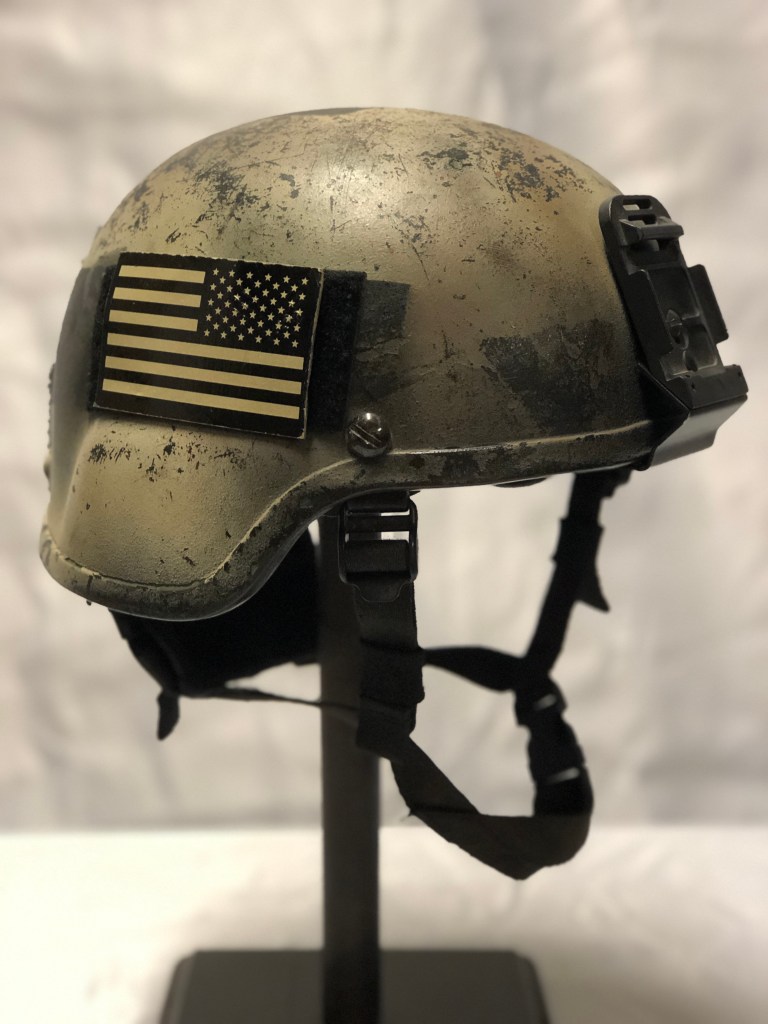
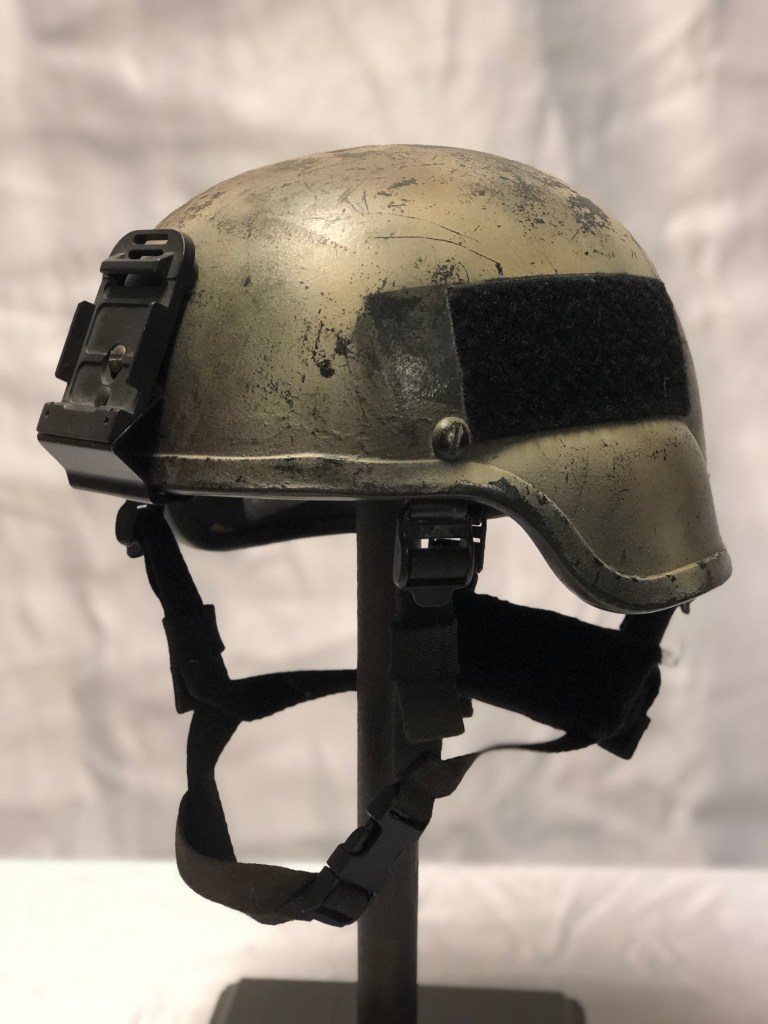
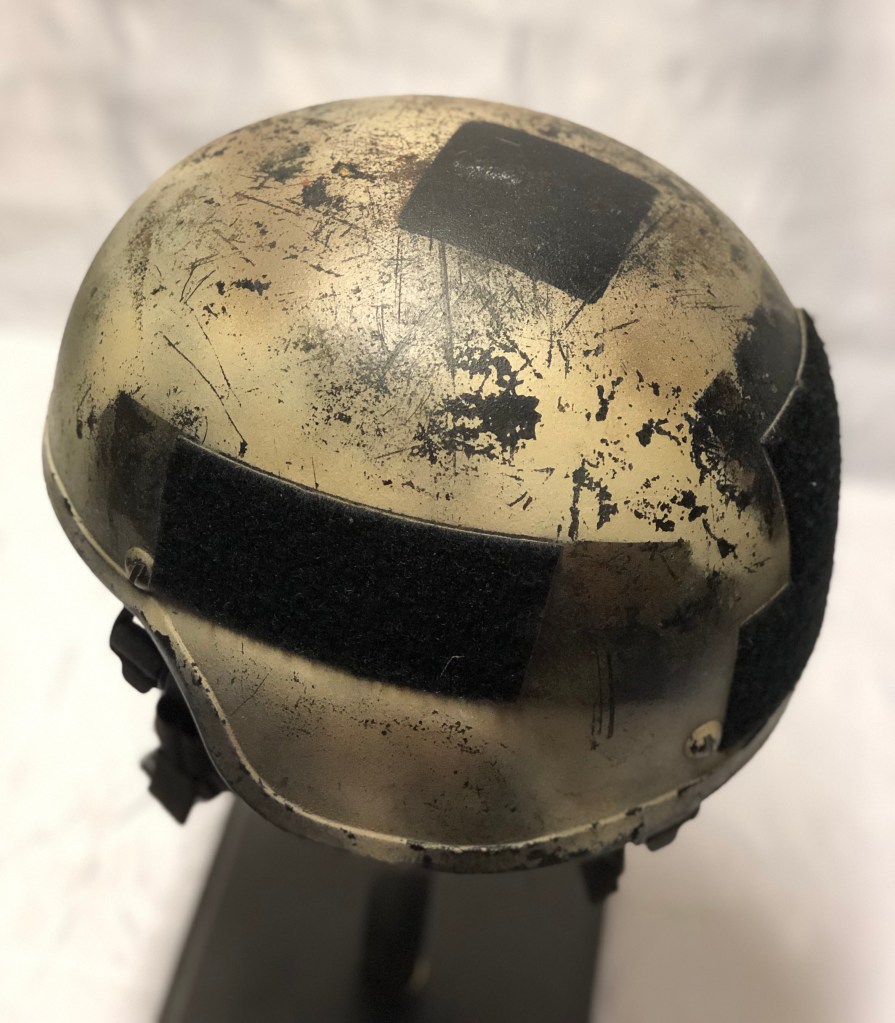
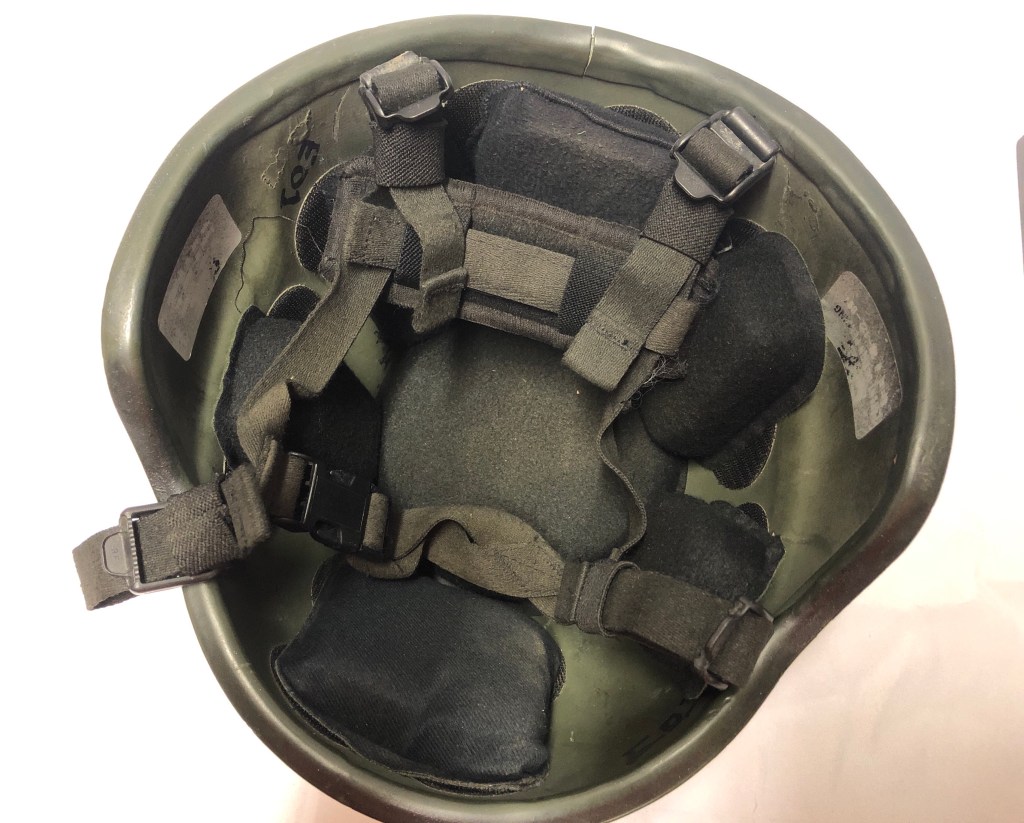
An original helmet with sprayed camouflage pattern and strips of Velcro added for various of attachments including NVG mount accessories or patches. Special Operations Forces (SOF) troops typically customize or personalize their helmets to meet their operational needs or individual preference. This TC2000 is made by CGF Gallet, the original manufacturer of the helmet series before the company was bought out by MSA. The CGF version was the first TC2000 adopted by US. Military exclusively for SOF units while the conventional units still had PASGT helmets.
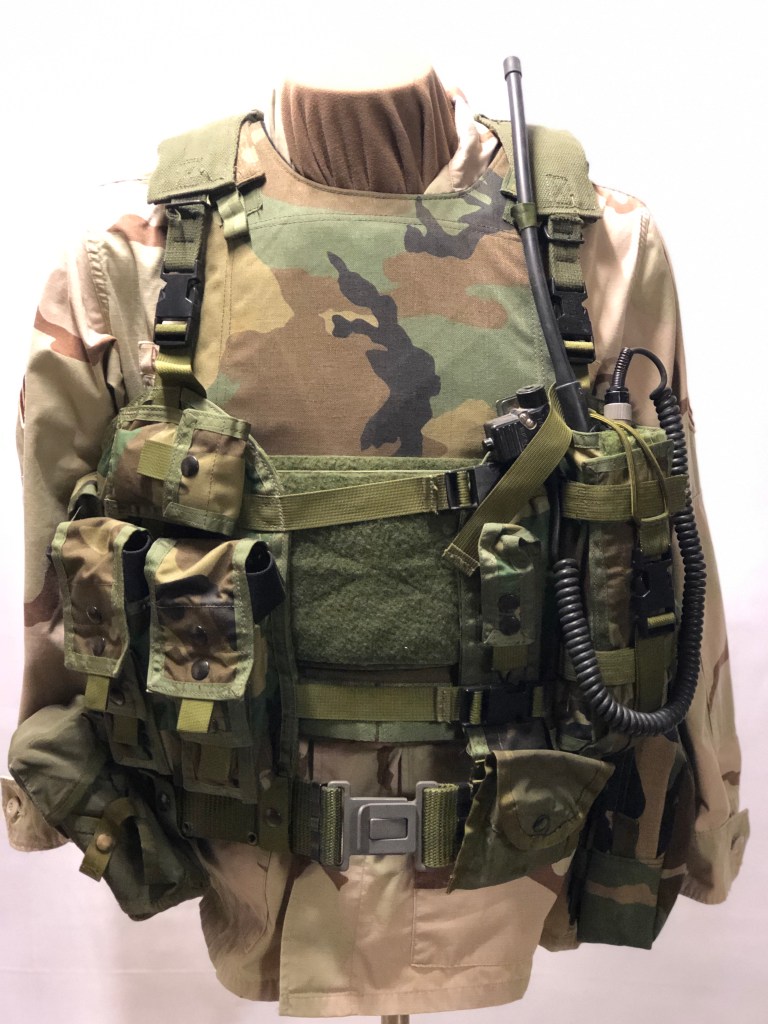
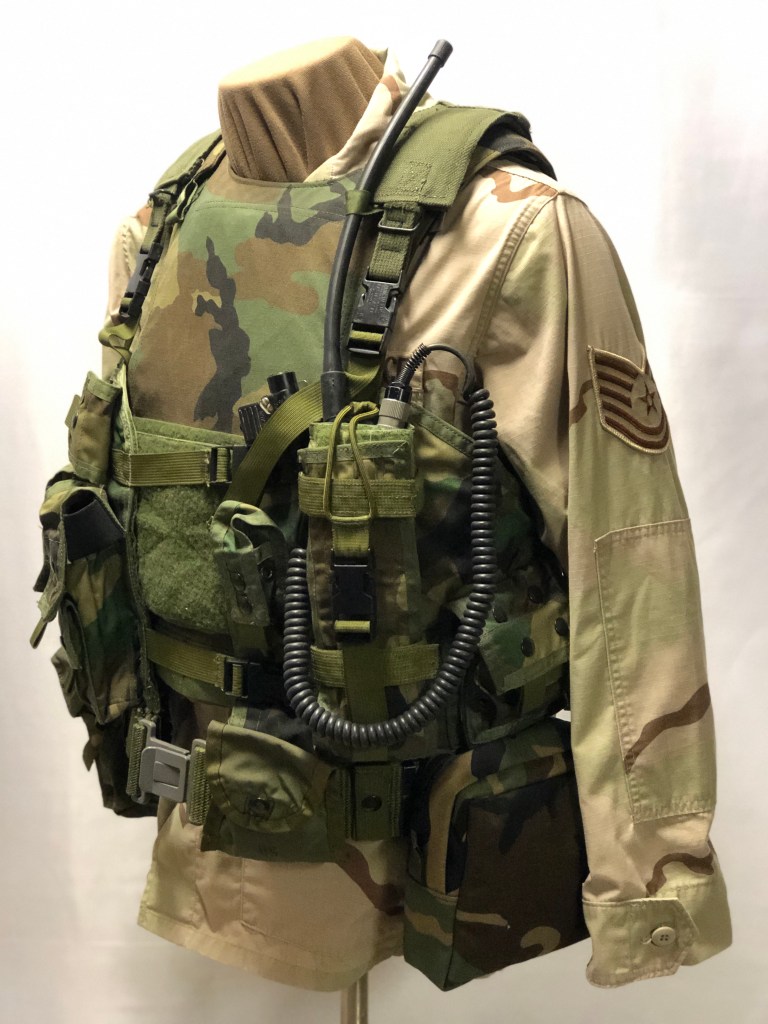
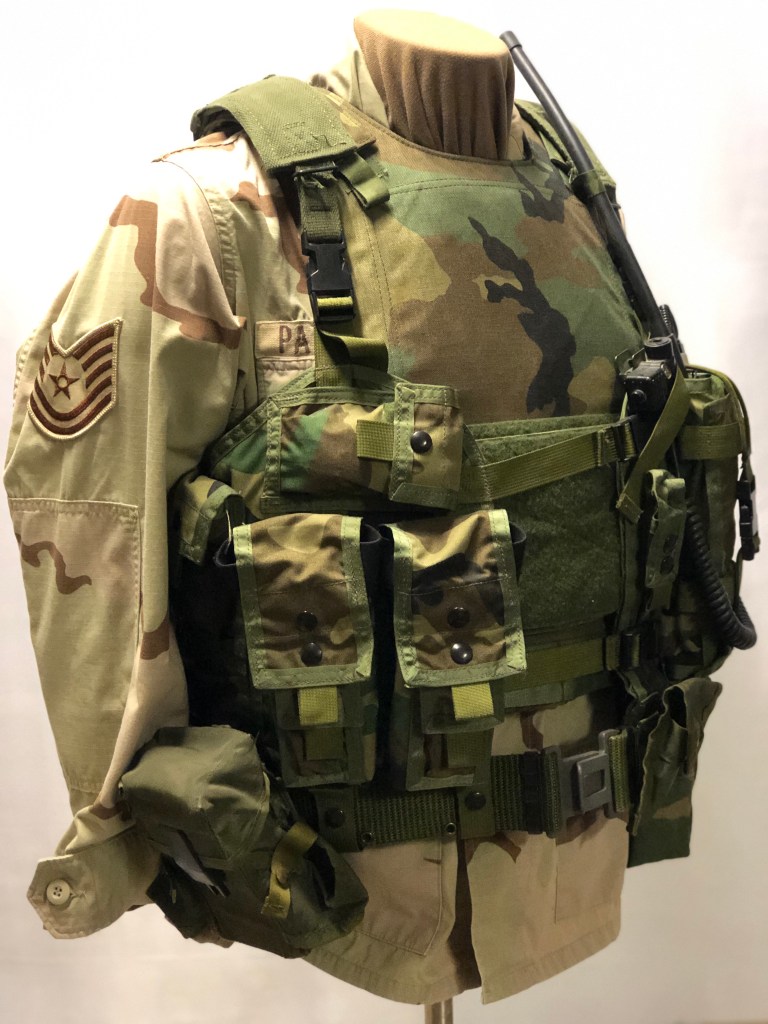
The CCT LBV has been modified; the factory shoulder pads were replaced with Vietnam War era M-1956 H-harness by operator, while the real reason unknown but the vest shoulder straps had reputation of being weak and old Vietnam War era shoulder pads has more slim feature. While the vest was originally designed for Combat Controller team, it was also used heavily by Pararescue Jumpers due to radio pouch.
Tech. Sgt. Keary Miller, pararescueman from 123rd Special Tactics Squadron, won silver star before the award upgraded to Air Force Cross for his actions in the Battle of Roberts Ridge (Takur Ghar, Afghanistan). This equipment set up displayed here at GWOT museum is based on equipment Miller worn in the battle. The equipment originally worn by Miller is displayed at Warrior Airman exhibit at National Museum of the United States Air Force.
(From left to right) Tech. Sgt. Keary Miller, Senior Airman Jason Cunningham and Staff Sgt. Gabe Brown about three weeks before the battle. Behind them is a MH-47E, the same type of helicopter that took them to Takur Ghar. (U.S. Air Force photo)
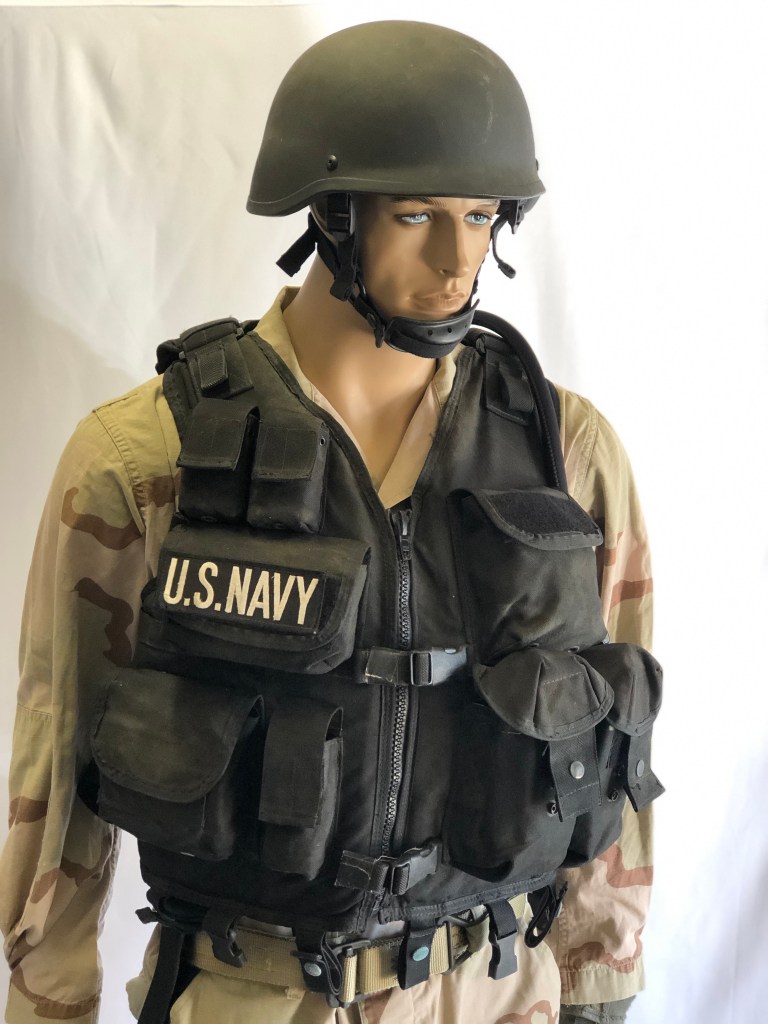
US. Navy VBSS: “Visit, board, search, and seizure” is a tactical team consisted of volunteers. The qualified sailors may volunteer to be on their assigned ship team, he/she would be attend VBSS qualification and training. VBSS is not part of Navy rating (job classifications); VBSS team members would have normal assignments within ship until the need arise.
After Operation Desert Storm (Or Gulf War) the United Nations imposed sanctions on Iraq which continued throughout Operation Iraqi Freedom. US. Navy occasionally deployed a ship to maintain the sanctions. The VBSS teams supported Navy ship by patrolling with Rigid inflatable boat, overseen the Iraq’s commercial traffic and oil terminals, visit and board ships if necessary, to ensure Iraq did not violate the sanctions by importing/exporting prohibited cargos.
During Operation Enduring Freedom and Operation Iraqi Freedom, the VBSS capacity has expanded to anti-terrorism; they board and search vessels for weapons, drugs, and terrorists being trafficked into the Middle East. Additionally, VBSS teams were heavily involved with anti-piracy operations in Africa when their ship was being deployed in support of OEF-HOA (Operation Enduring Freedom-Horn of Africa).
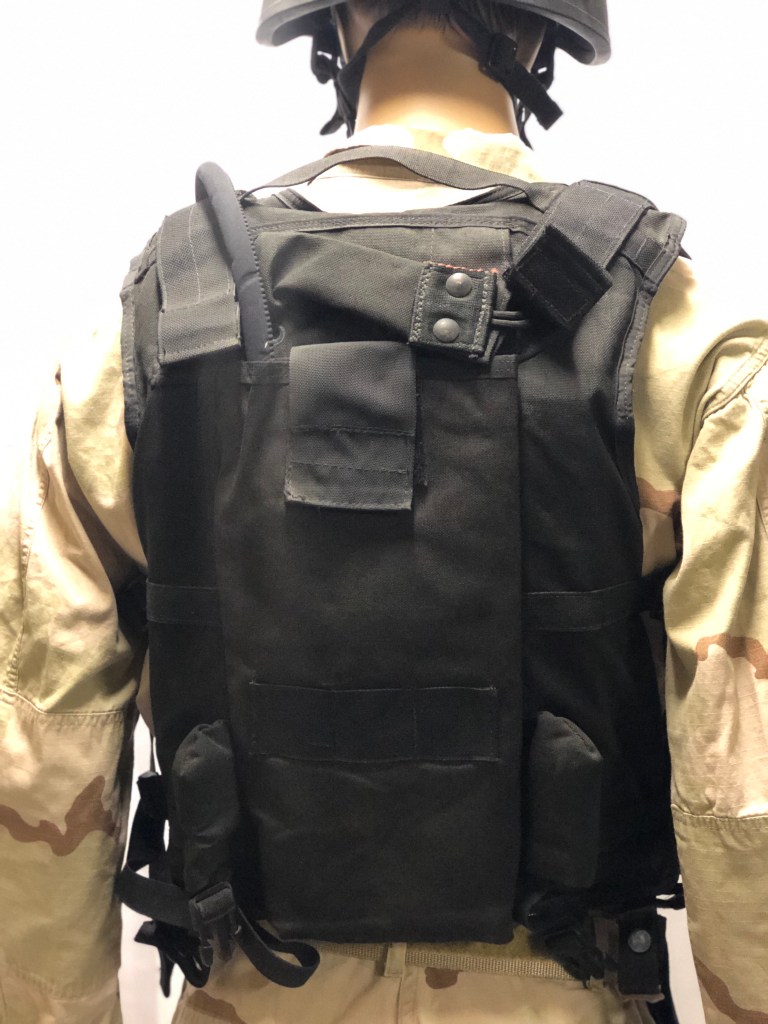
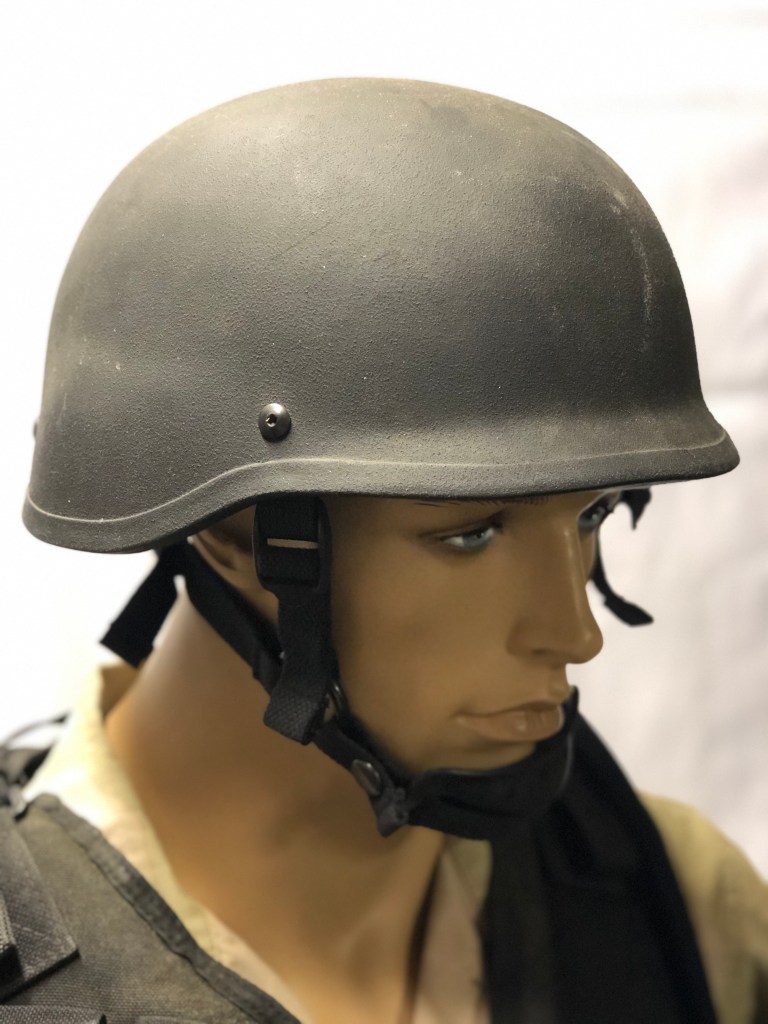
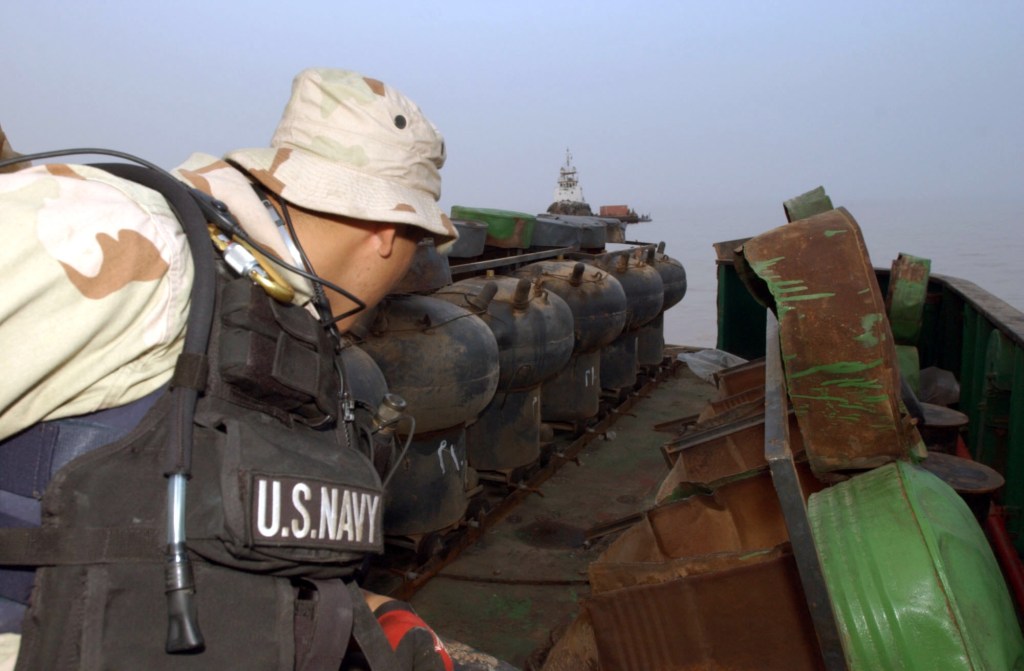
The tactical flotation vest made by London Bridge Trading, various of pouches for ammo, first aid kit, and other essential pieces of equipment. This vest doesn’t have any ballistic protection. The newer version of flotation vest would have soft armor and hard plates (Not shown).The back of vest has pouches for hydro-bladder and radio. RBR F6 Combat helmet. The typical helmet of US. Navy VBSS in early GWOT. At sea aboard USS Lake Champlain (CG 57) Jan. 15, 2002 — The leader of the Vessel Boarding Search and Seizure (VBSS) team from aboard USS Lake Champlain gives the operation briefing before conducting a search of a merchant vessel. Maritime Interception Operations (MIO) are being conducted by the U.S. Navy in cooperation with coalition ships in support of Operation Enduring Freedom. U.S. Navy Photo by Photographer’s Mate 1st Class Greg Messier. (Image courtesy of Navy https://www.navy.mil/view_image.asp?id=620)The Arabian Gulf (Mar. 21, 2003) — A Vessel, Board, Search and Seizure (VBSS) team member inspects camouflaged mines hidden inside oil barrels on the deck of an Iraqi shipping barge. The shipping barge was intercepted and inspected by Coalition Maritime Interdiction Operation (MIO) and Vessel Board Search and Seizure (VBSS) teams from the patrol craft USS Chinook (PC 9) in the early hours of Operation Iraqi Freedom. Operation Iraqi Freedom is the multi-national coalition effort to liberate the Iraqi people, eliminate Iraqs weapons of mass destruction and end the regime of Saddam Hussein. U.S. Navy photo by Photographers Mate 2nd Class Richard Moore. (Image courtesy of Navy. https://www.navy.mil/view_image.asp?id=6036)
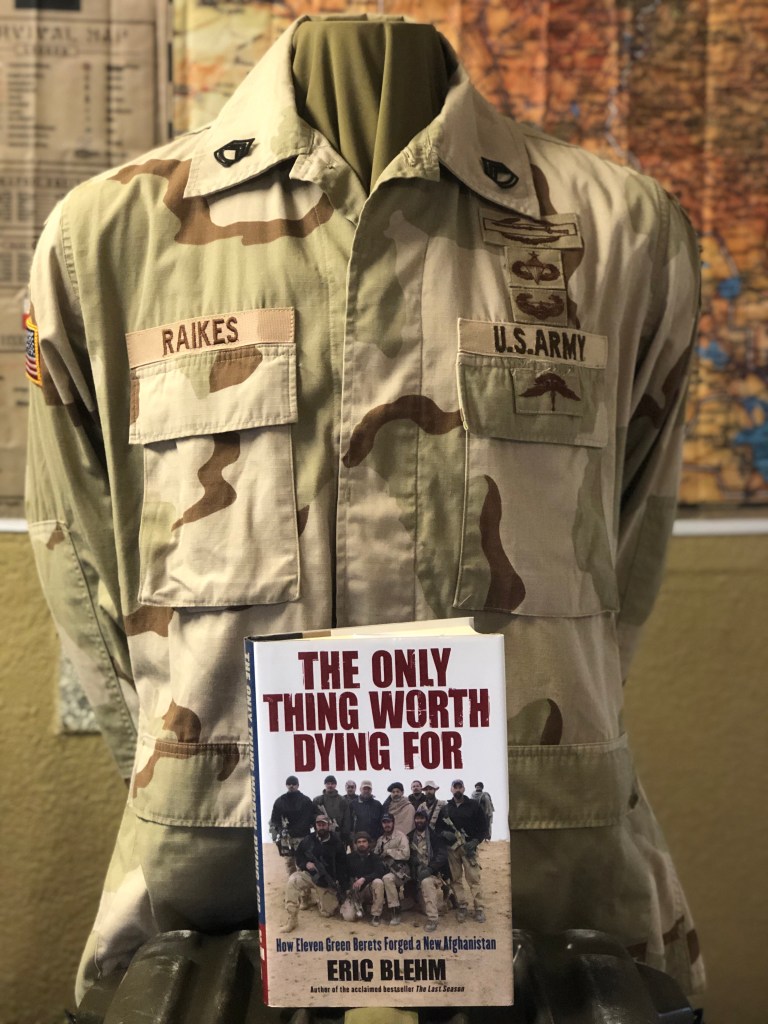
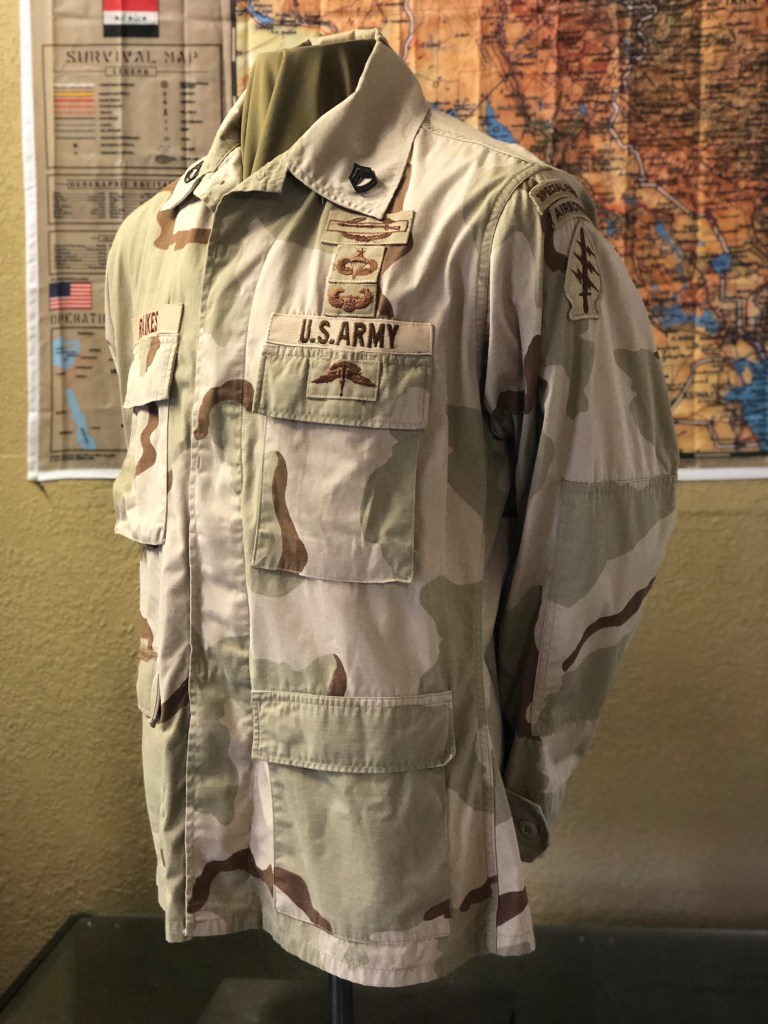
SSG Ronnie Raikes. ODA 574, 3rd Battalion, 5th Special Forces Group.
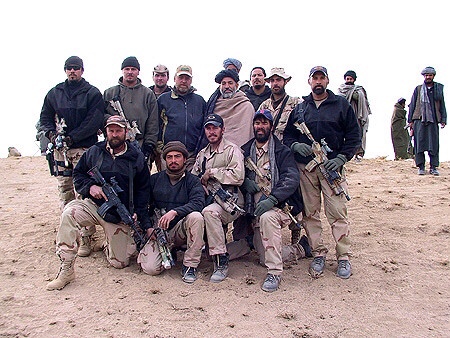
Other ODA (Operational Detachment Alpha) teams from the 5th Special Forces Group were being inserted into North Afghanistan, meeting with Northern Alliance fighters. On other hand, ODA 574 had critical mission in South Afghanistan. The United States faced the greater challenge in south due to the majority of population was of Pashtun ethnic group; Taliban’s root ethnicity. The exiled Afghan politician, Hamid Karzai was United States’ key to winning Pashtun tribes’ hearts and minds and have them join the cause against the Talibans and Al Qaeda.
Karzai supported and funded Afghan mujahideen during the Soviet Union’s occupation of Afghanistan. After Taliban came to power, he outspoke against Talibans, and refused to accept the position within Afghanistan’s Taliban government, then he was forced to exile. Karzai continued to work against Talibans in exile. He is well-respected and recognized by Afghan people. The United States recognized Karzai’s qualities and invited him to assist the United States’ efforts in war on terror.
On November 14, 2001, The ODA 574 escorted Karzai and infiltrated into South Afghanistan. They successfully infiltrated, engaged with local tribes, formed new allies and Karzai built a militia consisted of Pashtun fighters to revolt against Taliban regime. Then tragedy struck: JDAM (Joint Direct Attack Munition) bomb dropped on the ODA team and Karazi’s fighters by mistake. It was costly one: Three ODA team members and twenty of Karzai’s fighters were killed. Ronnie Raikes and rest of the team were wounded, including Karazi. Right after the incident, Karzai was selected to be chairman of Afghanistan interim government committees. He eventually would become a president of Afghanistan.
The three KIAs were Master Sgt. Jefferson Donald “JD” Davis, Staff Sgt. Brian Cody Prosser, and SFC Daniel H. Petithory.
Ronnie Raikes was back in United States recovering from his injuries he sustained from the JDAM incident. Raikes and two other ODA 574 team members were invited to President Bush’s State of Union speech, where Karzai personally thanked them. Raikes sat with the First Lady Laura Bush and Hamid Karzai during the speech.
Ronnie Raikes and ODA 574’s story was told in book The Only Thing Worth Dying by Eric Blehm.
Raikes with First Lady and Karzai during State of Union speech. (Gettyimages)ODA 574 and Karzai. (Image from open source online)
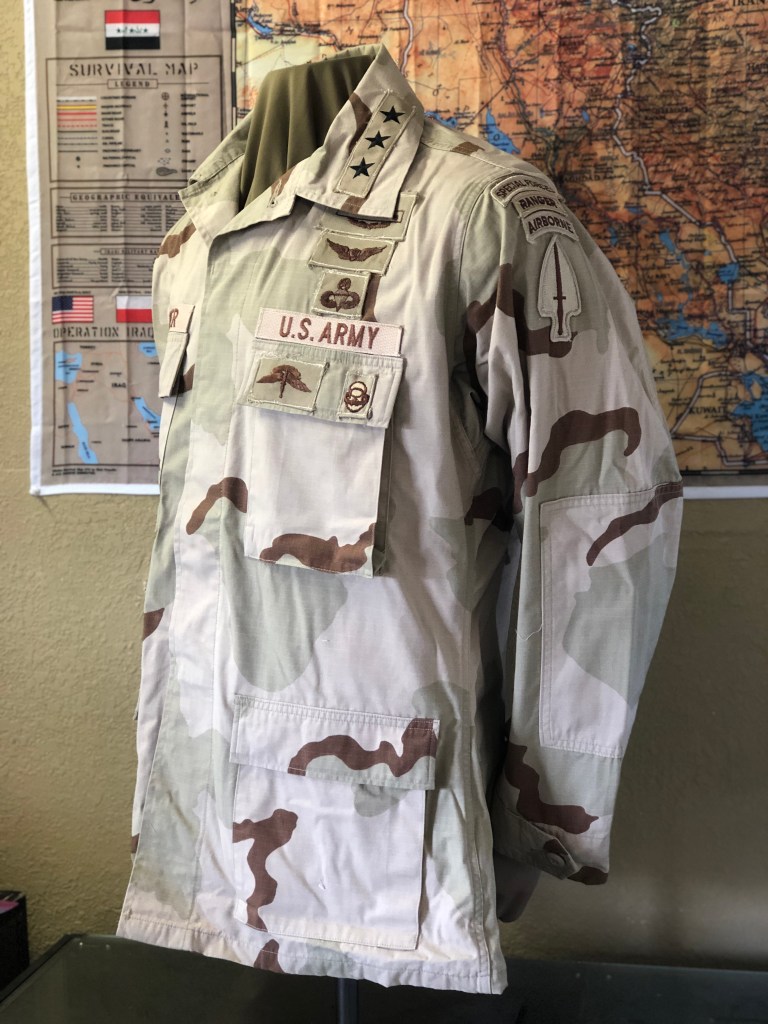
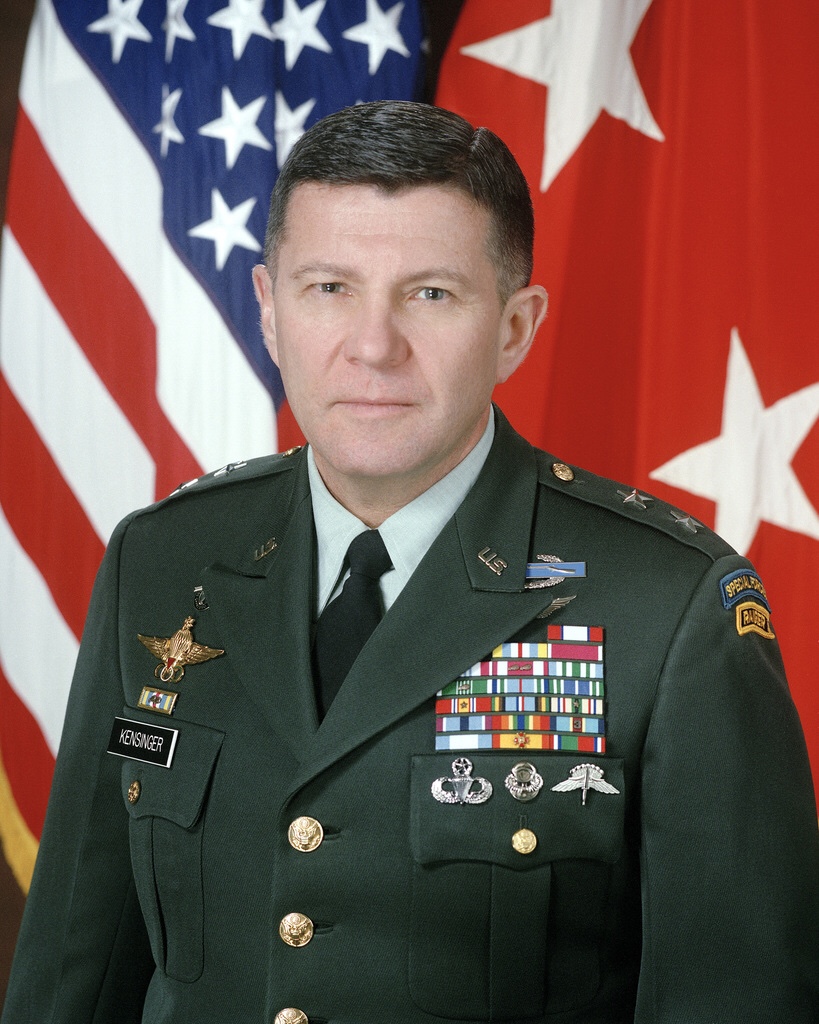
Lt. Gen. Philip Kensinger was the commanding general of US. Army Special Operations Command from 2002 to 2005.
US. Army Special Operations Command (USASOC) oversees US. Army’s special operation units including Delta Force, 160th Special Operation Aviation Regiment, 75th Ranger Regiment, Special Forces, and various of supporting companies and battalions such as Psychological Operations (PSYOP), Civil Affairs, Military Intelligence.
USASOC is Army’s compartment in the Special Operations Command (SOCOM).
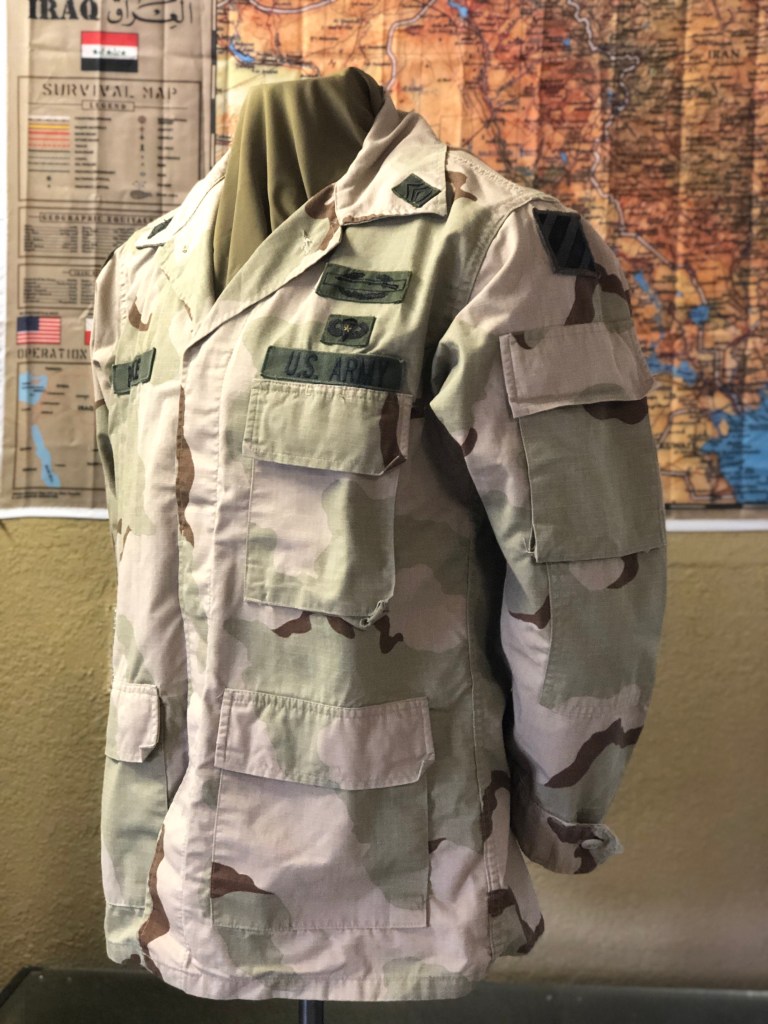
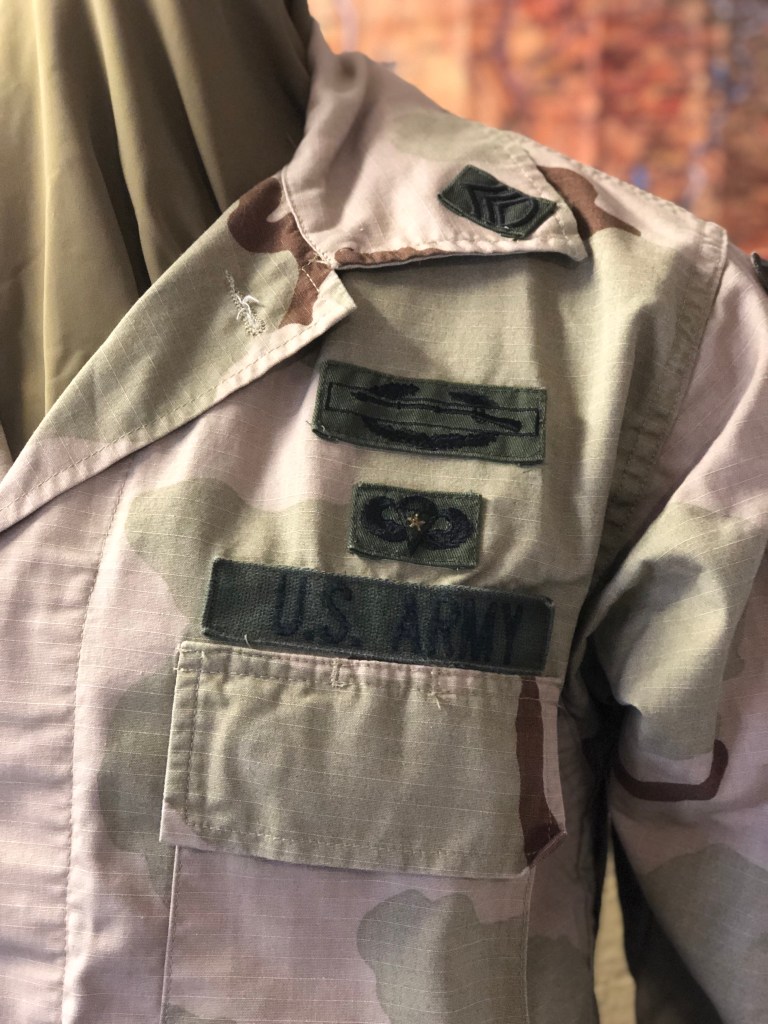
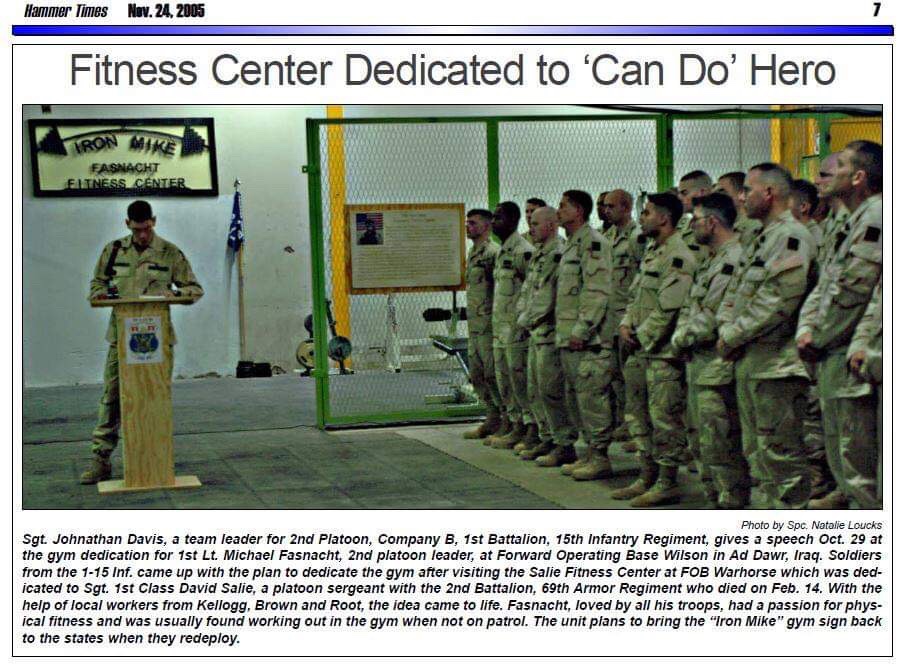
The 3rd Infantry Division was the spearhead during the invasion of Iraq. One brigade, particularly the 3rd had Olive Drab subdued patches (For woodland BDU), on their Desert Camouflage Uniforms opposed to typical desert subdued patches, possibly due to shortage of desert patches. After the invasion, 3rd Infantry Division returned to Iraq for second deployment in 2005-06. The 1st Battalion of 15th Infantry Regiment opted to continue wearing Olive Drab patches, as a throwback to the invasion, also it was believed that they done it for psychological reason; to instill the fear in the insurgents as most of them were in Saddam’s army during the invasion. (Anecdote is not yet to be verified). Other things that was unique to the 1/15 was the gaping of badges and modification of DCU, as shown on this example, one chest pocket was moved to left sleeve. (Image showing 1/15 with modifications at bottom).
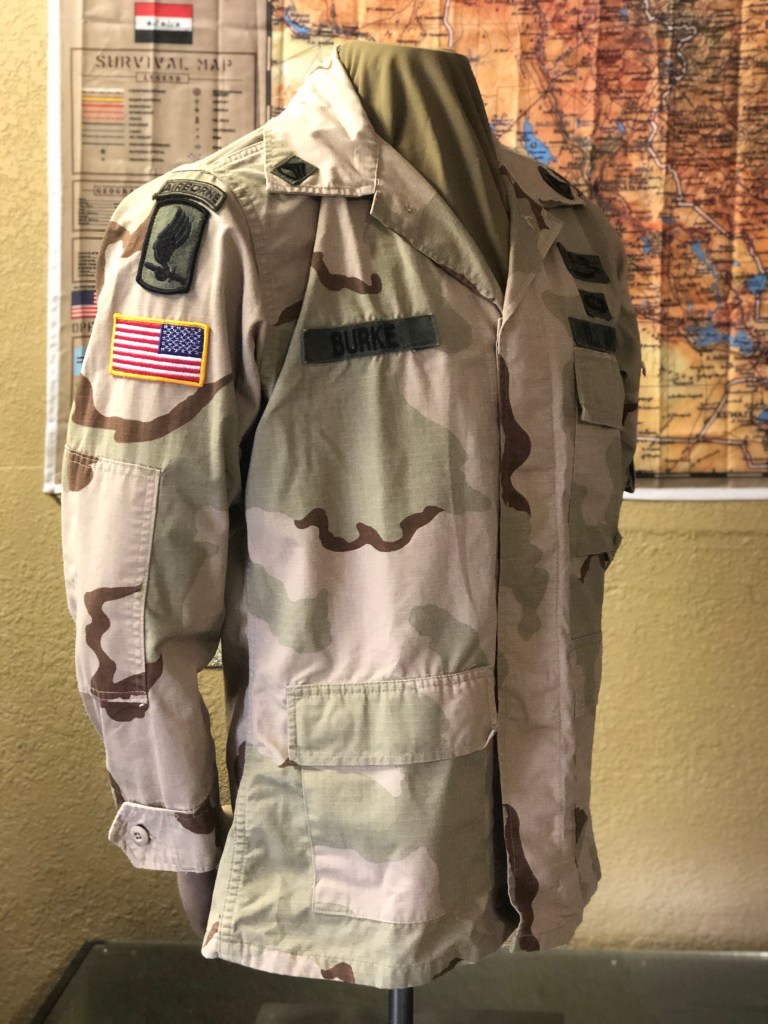
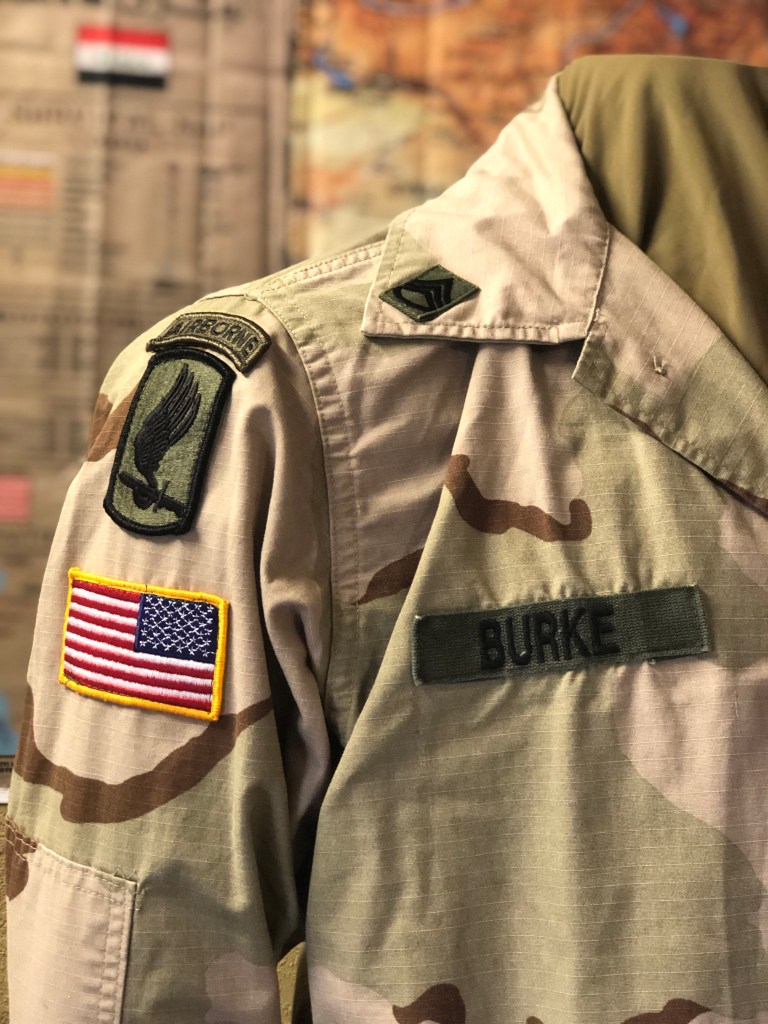
This DCU belonged to SSG Burke. Before he He was with the 173rd Airborne Brigade during the invasion of Iraq and participated in the Operation Northern Delay; a combat jump into Northern Iraq. His name is listed under chalk 5 in the published combat jump manifest.
In 2005-2006 the 173rd Airborne Brigade had first deployment to Afghanistan.
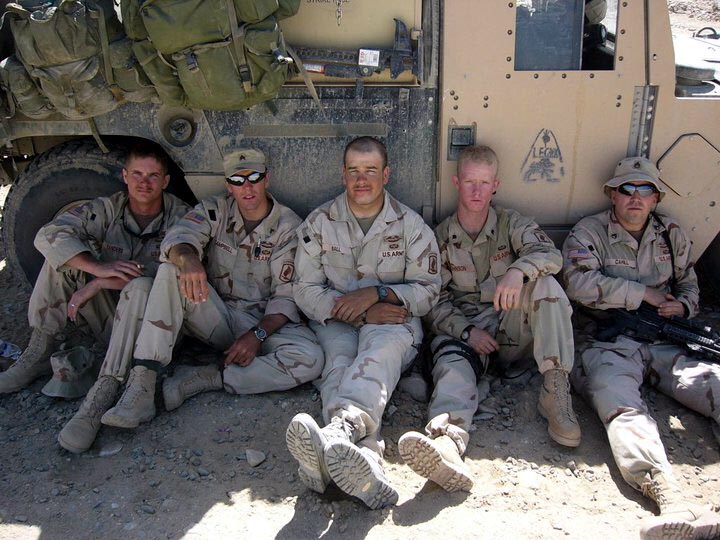
The 173rd Airborne Brigade authorized the modification of uniforms on Brigade level. Everyone had their Desert Combat Uniforms (DCU) modified by removing the existing pockets on uniform to upper sleeves. That way pockets would be accessible and useful while wearing a body armor. The DCU and BDU (Battle Dress Uniform or known as woodland) had a outdated design which have four pockets on uniform. Two on chest and two at bottom front, which was designed to be worn with old Load Bearing Equipment without body armor. Those pockets would’ve been covered by body armor, rendered them useless and inaccessible. Earlier that practice of modifying uniforms was typical for Special Operations Forces, then more and more regular army soldiers copied the idea and worn them only in field because it was not authorized or frowned upon by higher ranking traditionalists in the regular army. However, in 2005, the 173rd airborne brigade was one of few units that had finally authorized the modification on DCU for deployment.
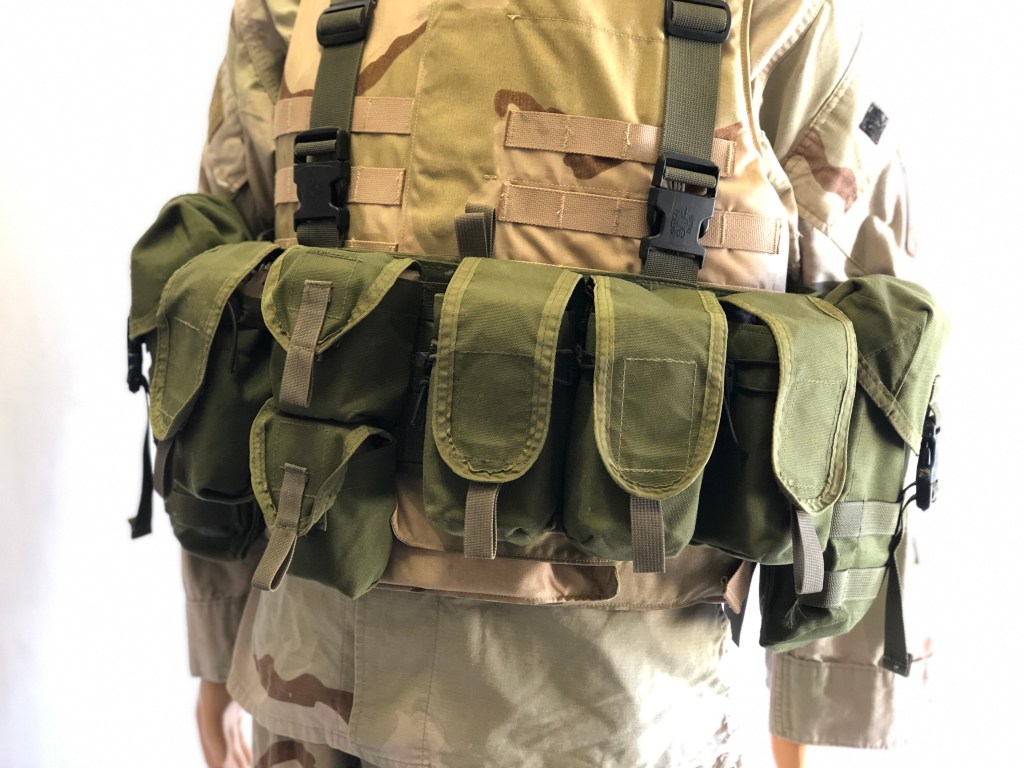
Many of soldiers opted to purchase aftermarket tactical gear because chest rigs and enhanced rucksacks were favored over standard issue MOLLE II equipment. The popular privately purchased equipment was Tactical Tailor’s Modular Assault Vest (MAV) chest rig and Tactical Tailor’s Modified ALICE (MALICE) rucksack.
Also it was the period when Army had finally issued body armor and MOLLE equipment in desert camouflage in more wider scale. Since 2001 woodland camouflage body armor and equipment worn over desert uniform had been a familiar sight due to the lack of desert equipment at the time.
173rd Airborne Brigade NCO with Tactical Tailor MAV chest rig.
Image source: http://www.173rdairborne.net/AF-1.htmTactical Tailor MAV.173rd Airborne Brigade soldiers in their modified uniforms. Note the Tactical Tailor MALICE tuck hanging on side of Humvee.
Image source: http://www.173rdairborne.net/AF-1.htmMSA Advanced Combat Helmet (ACH) or also known as MICH by veterans. It has a Night Vision Goggles (NVG Mount). Close-up of pocket on sleeve modification. The black Velcro is for infrared or glint square (To identify friendly/foe while Night Vision Goggles is in use). The insignia is of the 173rd Airborne Brigade.
Also note the hand drawn Red Cross on a pouch to indicate this pouch holds Individual First Aid Kit (IFAK).
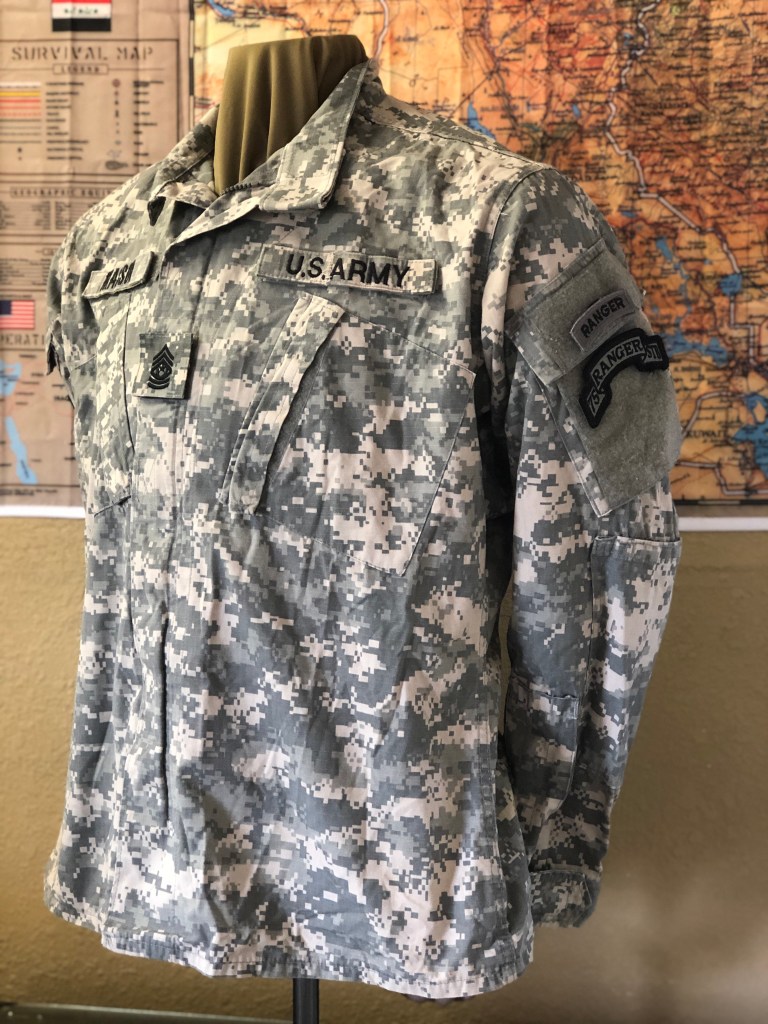
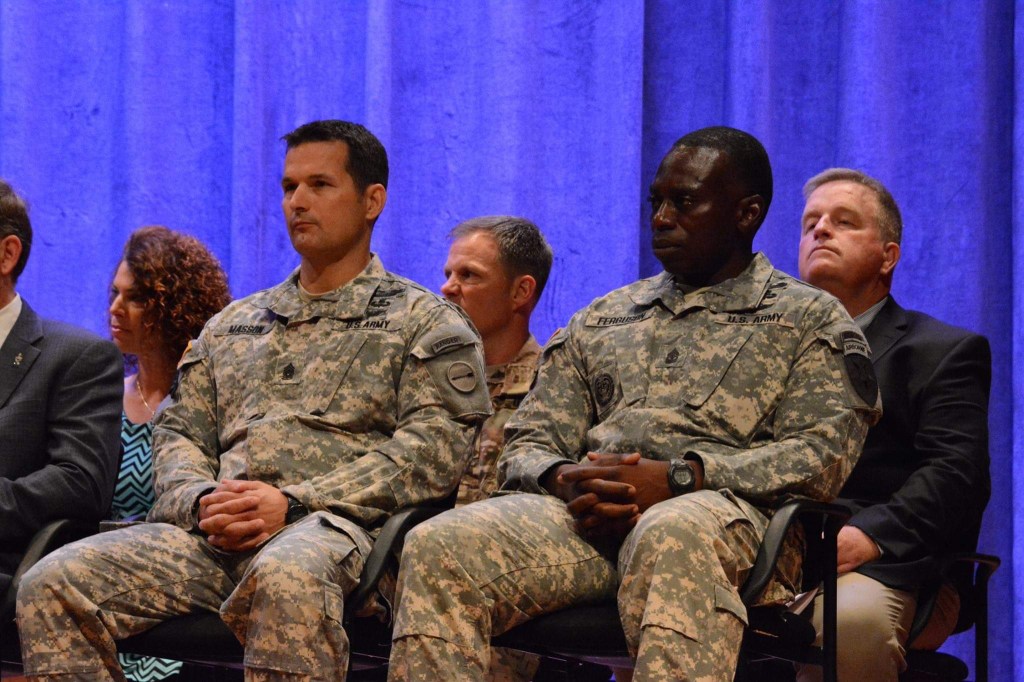
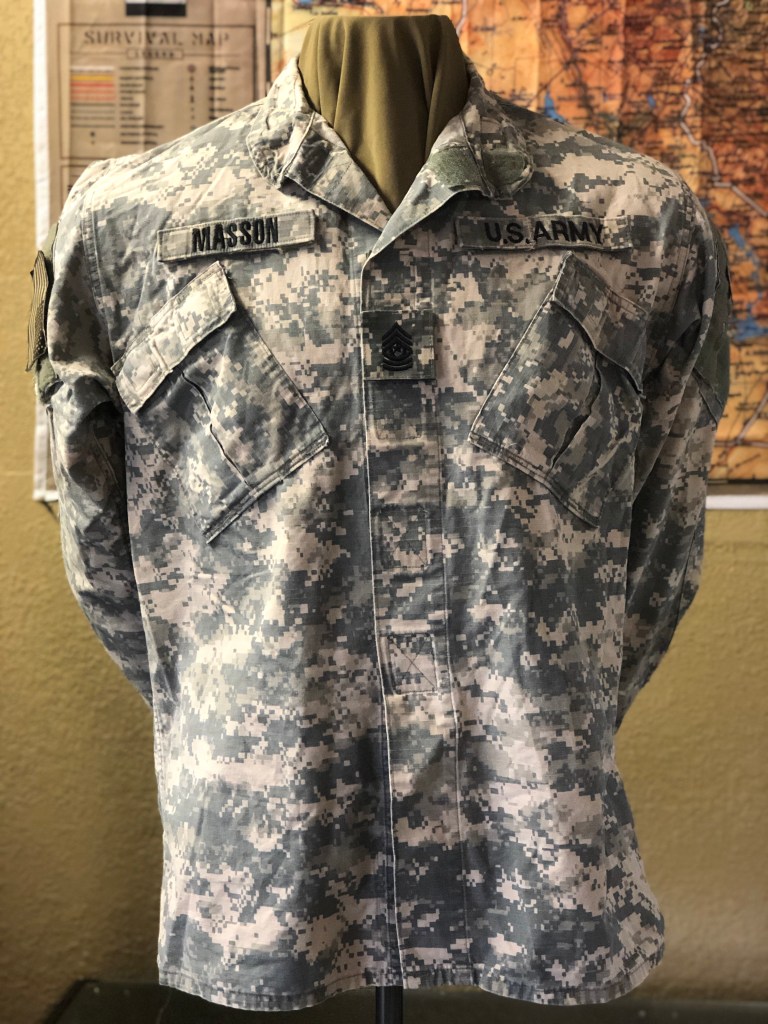
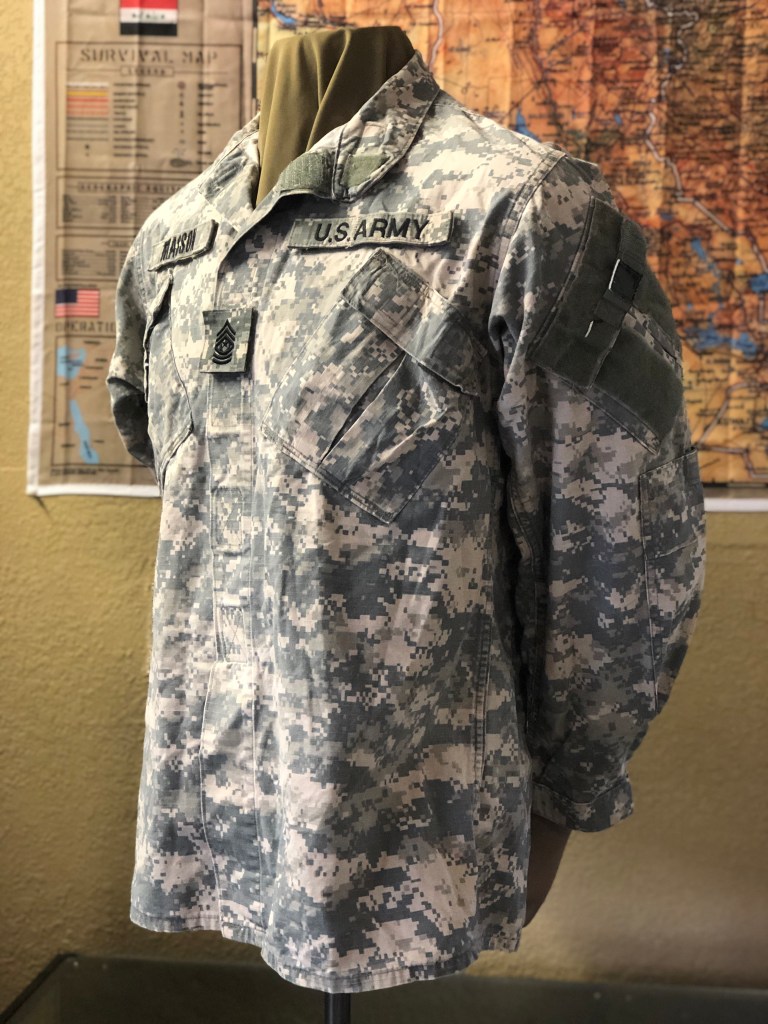
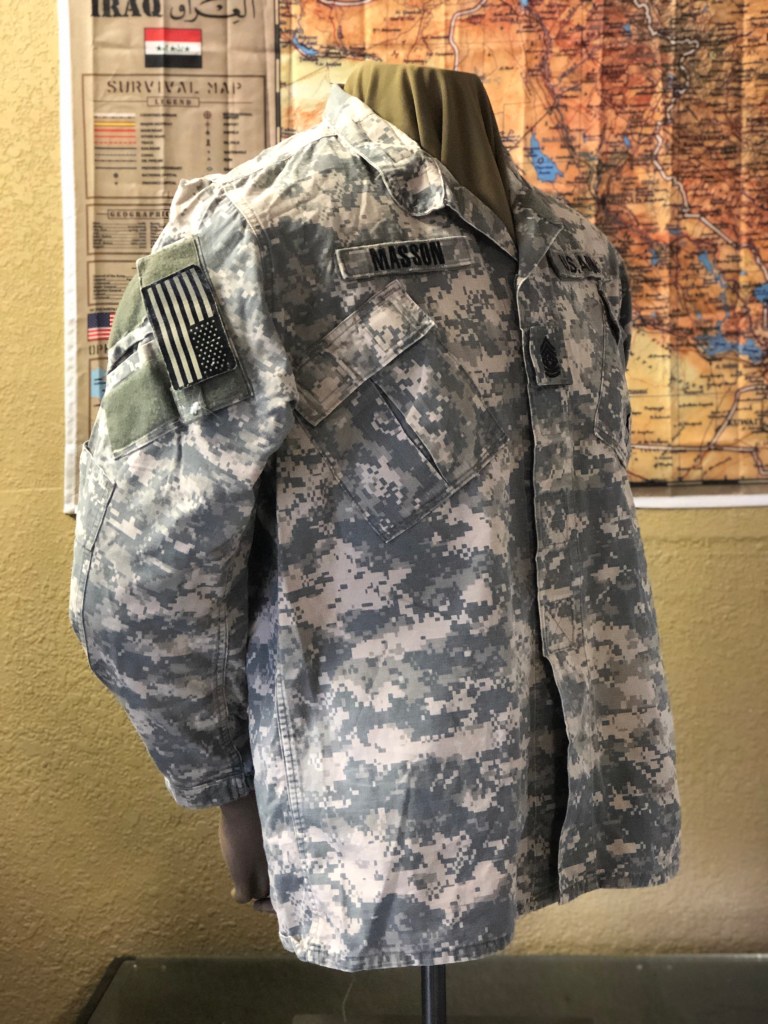
Command Major Sergeant Michael Masson was in the 1st Battalion, 75th Ranger Regiment for most of his career, he became Command Major Sergeant (CSM) of Ranger Special Troops Battalion, then eventually assigned to Asymmetrical Warfare Group (AWG) to be CSM of Able Squadron.
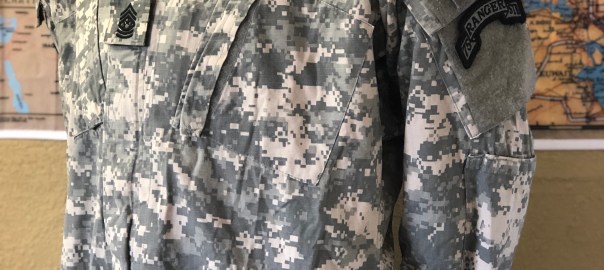
RSTB scroll with Ranger tab. The tab is earned upon completion of Ranger School. Command Sgt. Maj. Michael Masson, Asymmetric Warfare Group ABLE Squadron command sergeant major and former Regimental Special Troops Battalion command sergeant major; and Sgt. Maj. Harry Ferguson, 1st Joint Communications Squadron Joint Communication Support Element (Airborne) and former Regimental Signal sergeant major, during the 2015 DHMOR ceremony at US Army Fort Benning, 23 June.
Image and subtitle source: The 75th Ranger Regiment Facebook page
US. Army formed Asymmetrical Warfare Group (AWG) in 2005 in response to challenges conventional Army units faced in Iraq and Afghanistan. AWG is consisted mainly of operators from various Special Operations units. In Masson’s case, he brings in valuable experience and expertise from his career in the 75th Ranger Regiment. The AWG’s mission is to provide the support to conventional army units by attaching to them on their operations, observing and analyzing their foe’s threat and tactics, then advising and developing solutions and trainings for a unit to enhance their combat capabilities.
AWG operators were issued unique uniform set made by Paraclete for field wear. It has many features differs from standard ACU set such as Velcro style, pockets placements. AWG seldomly worn unit shoulder sleeve Insignia on operations.
AWG operators wearing their Paraclete uniforms. Photo source: Open Source.
Author’s note: The general information gathered on CSM Masson and units for this article has been published online by US. Army so no OPSEC has been violated.
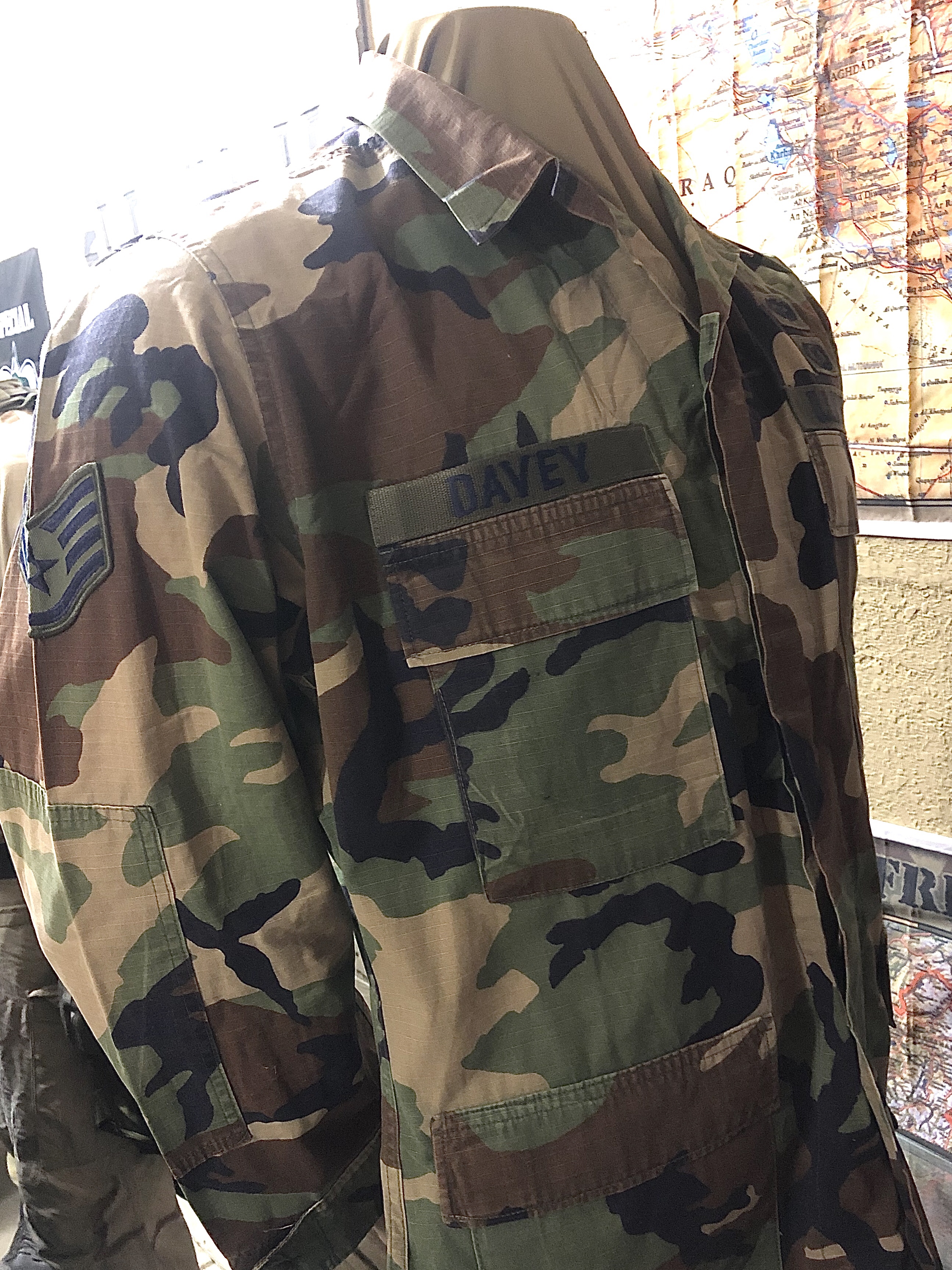
Peter Davey’s BDU.Peter Davey’s BDU.Peter Davey in Afghanistan. Image courtesy of AF.mil “U.S. Air Force Staff Sgt. Peter Davey (left) and Tech. Sgt. James Godlew, both from the 8th Air Support Operations Squadron tactical air control party out of Aviano Air Base, Italy, provide grid coordinates during an air strike exercise in support of Allied Strike II at the Grafenberg firing range in Germany on Nov. 7, 2008. Allied Strike II is a combined U.S. and coalition forces exercise that trains joint terminal attack control members in preparation for deployments in support of Operations Iraqi and Enduring Freedom.” Image and quote source: defense.gov
Peter Davey was a JTAC with US. Air Force 8th Air Support Operations Squadron based in Avaino AFB in Italy. He was attached to US. Army 173rd Airborne Brigade when he deployed to Afghanistan in 2010.
JTAC (Joint Terminal Attack Controller) is a qualified airman who directs combat aircrafts for Close Air support (CAS) and airstrikes from ground. Typically being attached to units in from other branches in combat zones.
For his actions in 2010 deployment in Afghanistan, Peter Davey was awarded Department of Defense’s African American History Month Recognition Award.
Below is a link to the USAF article about Davey and his recognition.
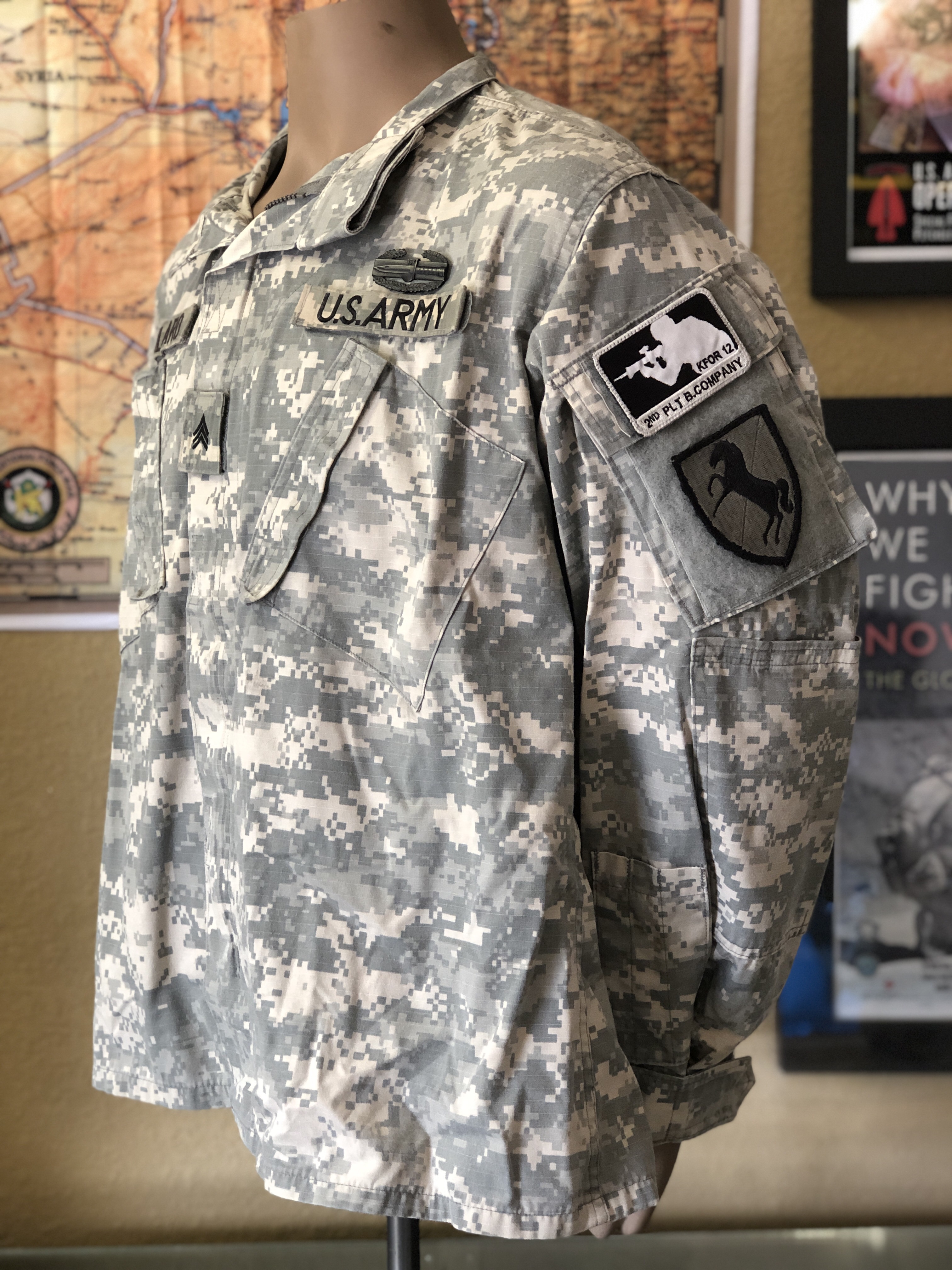
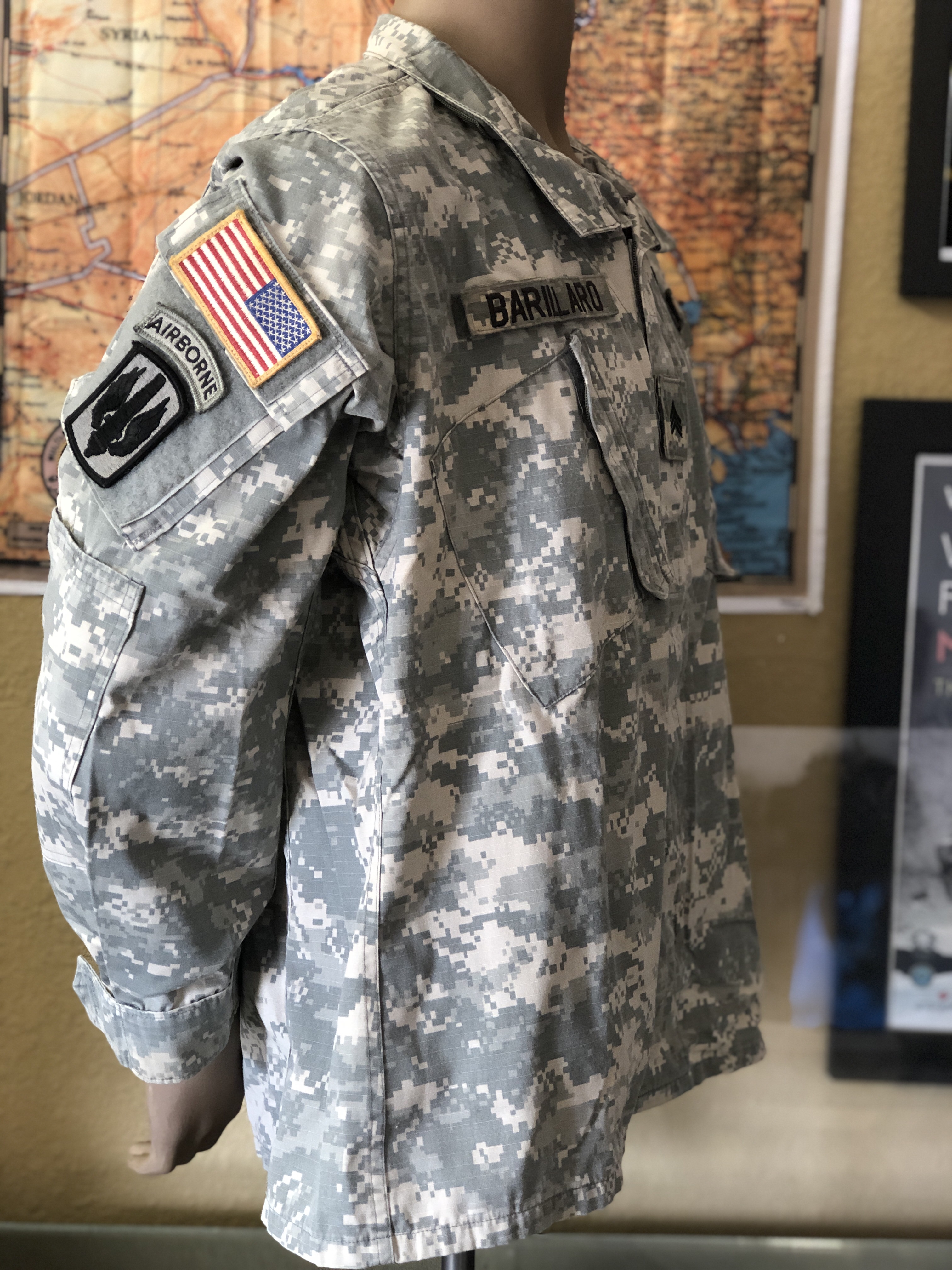
Sgt. Jeff Barillaro was an NCO and gunner for M1A2 Abrams tank. He enlisted in the Army upon graduation from High School. After four years, he left Army.
Following theSeptember 11attacks, Operation Enduring Freedom began, followed by Operation Iraqi Freedom. At the height of the Global War on Terror, a sense of duty returned to Barillaro. He re-enlisted. In no time he was deployed to Iraq with his original MOS as an Armor crewman. He led convoys and Barillaro saw his share of ambushes and gun battles.
Later, with 11th Armored Cavalry Regiment, Barillaro deployed to Kosovo for a NATO led peacekeeping mission with Kosovo Force (KFOR). Before he was discharged honorably.
As a result of his deployments, Barillaro was diagnosed with PTSD.
During his service, Barillaro discovered something that helped him cope with his PTSD was music and he was began writing, mostly hip hop and rap songs. After he completed his time in the Army, he founded Redcon-1 Music Group with main objective of using music to spread the awareness of PTSD and to help veterans struggling with PTSD.
Here is the ACU uniform set belonging to Barillaro. He had worn it in Iraq and then Kosovo. On it is a unofficial/unauthorized Kosovo deployment patch from his unit. It has the Combat Action Badge and Combat patch he earned in Iraq. There are also a few of his desert patches fixed on velcro for his modified Desert Combat Uniforms also worn in Iraq just before the transition to the new ACU. Note the helmet cat eye elastic band that he has taken off from his issued ACH.



















 GWOT museum