I grew up with a passion for military history and dreamed of serving in the United States Armed Forces. My family has a long military history, so my interest started at an early age. My bedroom was filled with G.I. Joes and military books, and at one point, my dad took me to a military surplus store in North Carolina, where he bought me a few pieces of surplus gear so I could play Army in the backyard. When I came of age, however, I realized that I would never be able to enlist because of my hearing impairment. Rather than give up on my dream and passion, I simply found a different direction for them. I became a military history enthusiast.
On September 11, 2001, the World Trade Center towers were struck by hijacked airplanes. In response, President George W. Bush ordered American troops into Afghanistan to fight the Taliban, who had provided sanctuary to Osama bin Laden and al-Qaeda. With access to the internet and extensive television coverage, I was exposed to Operation Enduring Freedom (OEF), the first major military campaign under what became known as the Global War on Terror (GWOT). My patriotism grew, and I became emotionally invested in the conflict. I read TIME magazine and countless stories and reports about military operations in Afghanistan.
Just two years later, President Bush announced that the United States would send troops into Iraq to remove Saddam Hussein’s regime from power. This introduced another major military campaign under the GWOT: Operation Iraqi Freedom (OIF). My eyes were glued to the television, watching FOX, NBC, and CNN for hours on end. I vividly remember watching journalist David Bloom, embedded with the 3rd Infantry Division, reporting from atop a fast-moving M88 armored recovery vehicle modified to carry satellite transmission equipment. He wore a desert camouflage chemical protective suit and press blue body armor as he brought viewers updates from the invasion of Iraq. I also remember watching Brigadier General Vincent Brooks deliver live CENTCOM briefings, explaining the objectives and progress of the invasion to the media.
As I got older, I discovered the hobby of collecting militaria. I initially collected memorabilia from World War II and the Vietnam War, but I never felt a particularly strong personal connection to those conflicts. Eventually, I shifted my focus to the Global War on Terror.
My interest in military history and military equipment had roots in my childhood. I grew up with my friend Ben LaBelle, whose father, Gary, was a full-time National Guard recruiter. Gary had a collection of old web gear and helmets that Ben and I would play with in their backyard, where we even dug a foxhole. Years later, Gary deployed to Afghanistan with the 86th Infantry Brigade. After returning, he gave me some of his uniforms from that deployment. I later had the opportunity to document his story. (Read Gary LaBelle’s story here).
Another important connection was Michael Phipps, a longtime childhood friend of my father’s who shared a passion for military history. We connected right away. Michael deployed to Iraq three times, first with the Pennsylvania National Guard and later for two deployments with the 1st Cavalry Division. He gave me his combat-worn uniform and gear, providing me with not only meaningful additions to my collection but also a personal connection to the experiences behind them.
Over the years, I built my collection, driven by the enjoyment of collecting and the research that came with it. Because my focus was on a conflict that was still unfolding, I had opportunities to meet and talk with many other veterans. Those personal connections took my collecting experience to another level. Still, I had no idea what I could ultimately do with my collection.
I had a room in my home that I called my “war room,” where I displayed my collection. I had never shown it to anyone in person. That changed on October 17, 2015, when Mike Millard, a combat veteran who served in Iraq with the 2nd Infantry Division’s Stryker Brigade, came to visit my home with his two boys.
I showed them my war room. Mike’s older son enjoyed trying on his father’s old uniform, which Mike had given me when we first met, along with other items from my collection. Mike explained to his boys that these were the things Daddy had worn while serving in the Army.
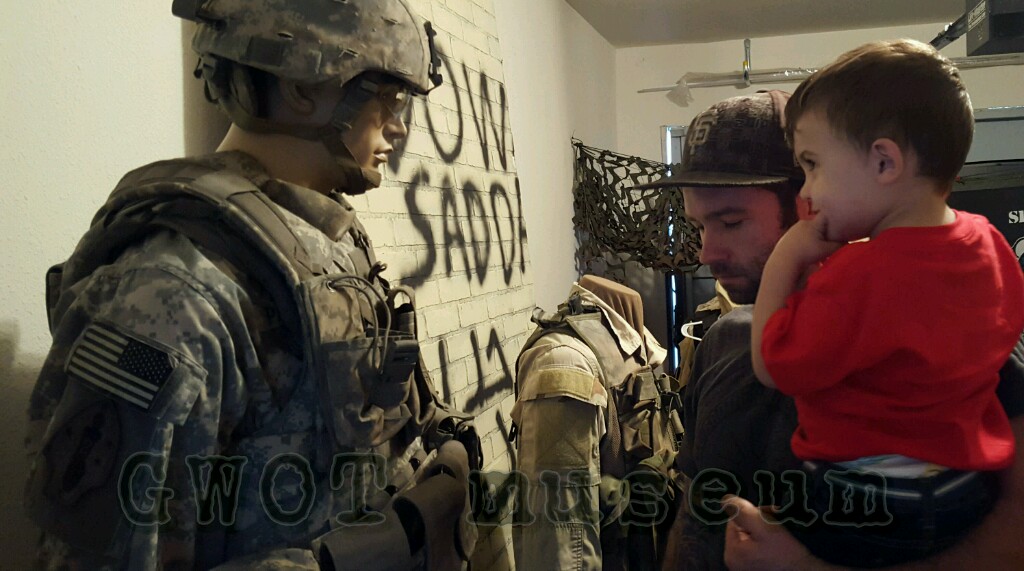
In the room, I also had a mannequin dressed in an Army Combat Uniform (ACU) and equipped with combat gear that had belonged to Michael Phipps. Although the uniform and equipment belonged to Michael, they were representative of the same period and similar gear that Mike Millard had worn during his service in Iraq. Mike picked up his youngest son and showed him the mannequin, explaining the uniform and equipment while sharing memories of his time in the Army. The toddler stared at the mannequin with great curiosity.
As Mike held his young son, he paused for a moment, reflecting on the display. I captured that moment in a photograph and shared it with his family. Everyone thought it was cute. However, when I looked at the photograph again the following day, I realized that it was more than just a cute picture. It captured something profound: a father sharing a part of his past with his son.
There was something about Mike’s expression that made it seem as though he was reliving memories of his military service. I can only imagine what was going through his mind at that moment, but the photograph had a profound impact on me.
That was when I finally understood why I collected militaria: veterans.
It was no longer just about my hobby or the items in my collection. It was about what I could do for the veterans who had worn them, carried them, and lived through the experiences they represented. It was about giving them recognition for their service and sacrifices and preserving their stories for future generations.
I became dedicated to establishing a stand-alone GWOT museum where veterans could be recognized and appreciated, and where a general audience could learn about the experiences of those who served. Although I do not yet have an official museum facility, I currently use the GWOT Museum website and social media platforms to retell veterans’ stories, share historical research, and showcase artifacts from the Global War on Terror. My vision is to create a museum that provides a historical perspective of the GWOT, preserves its material history, and ensures that the war and the men and women who fought in it will never be forgotten. In the meantime, I am actively exploring ways to make a physical museum facility a reality.

