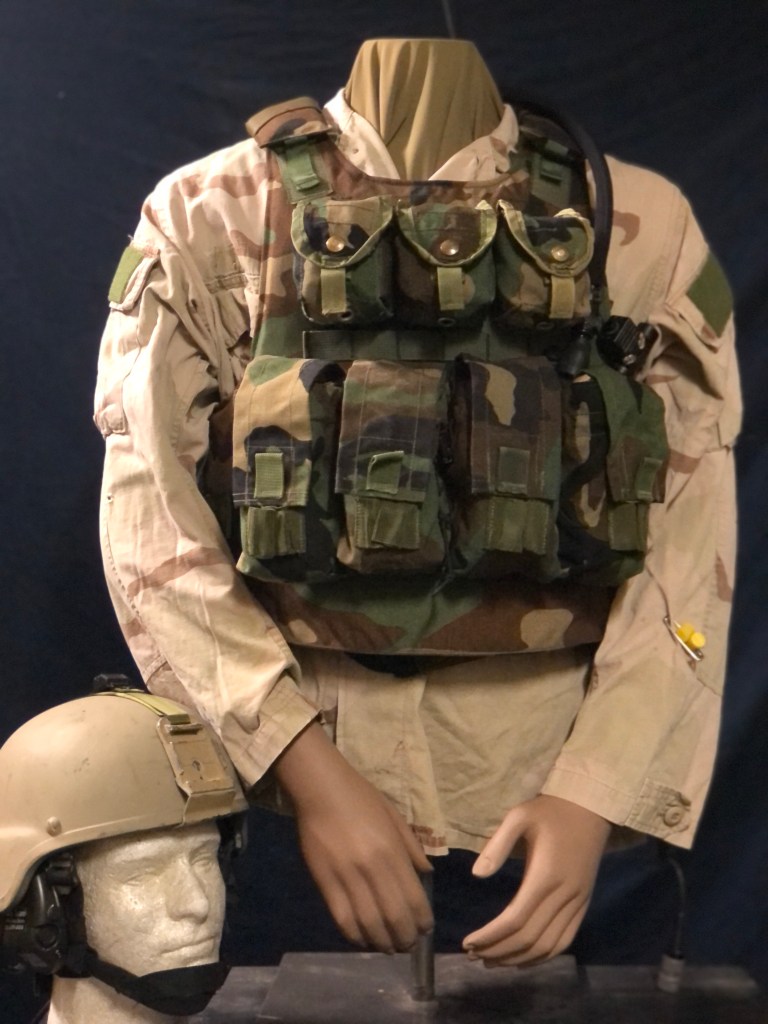
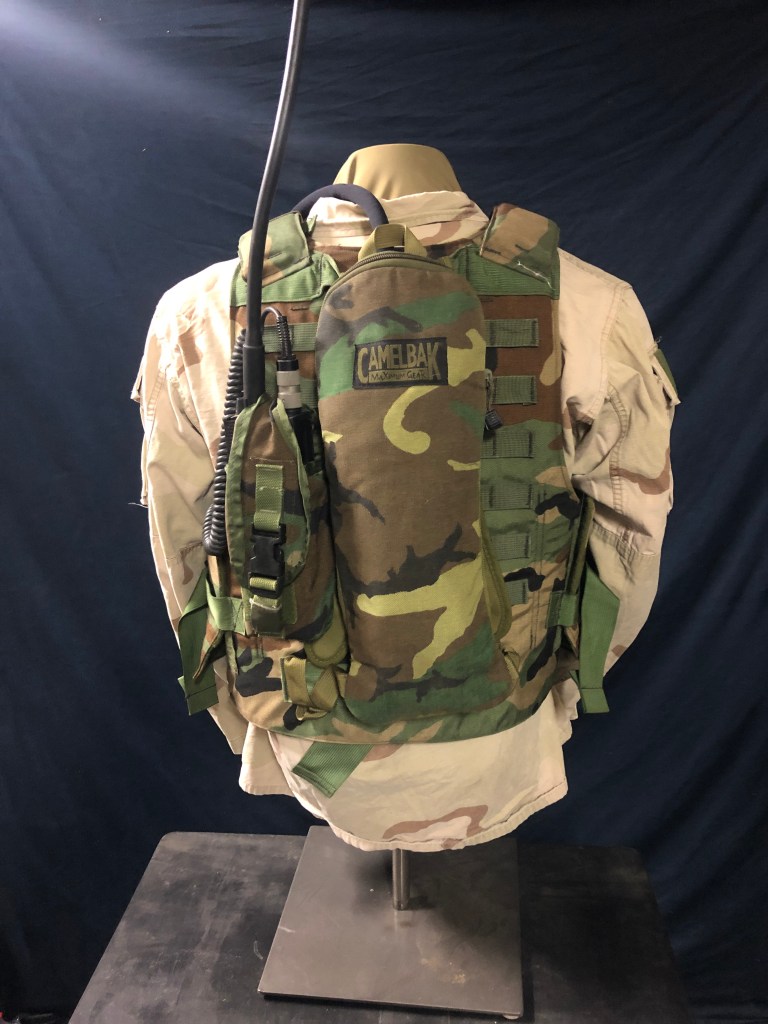
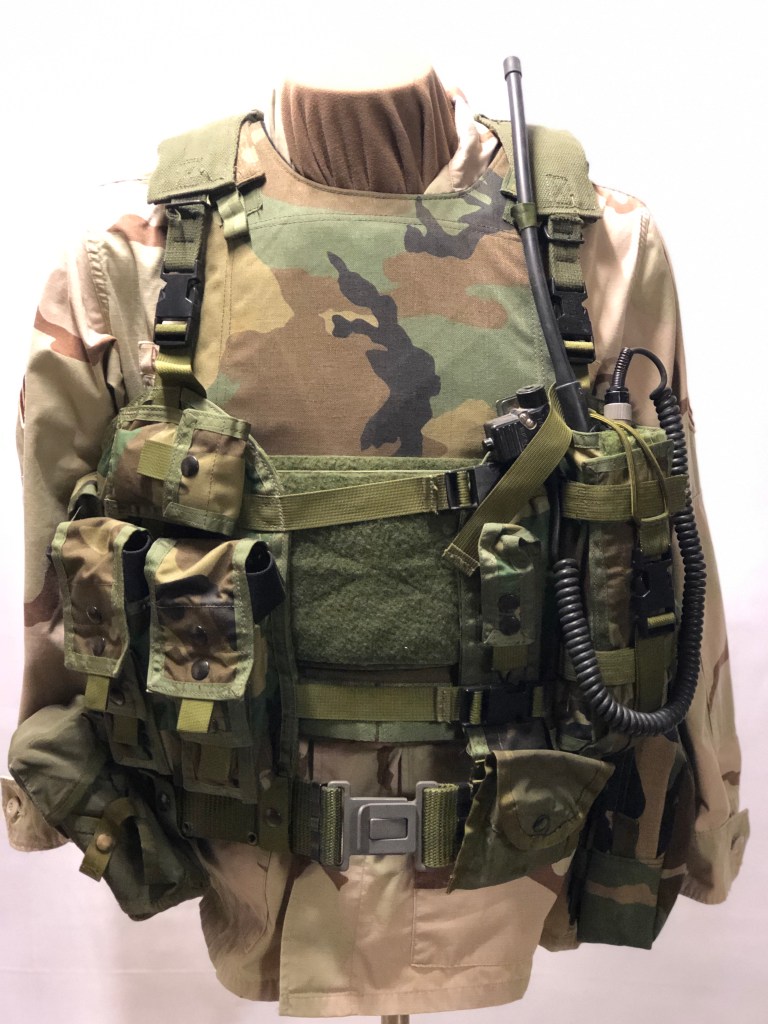
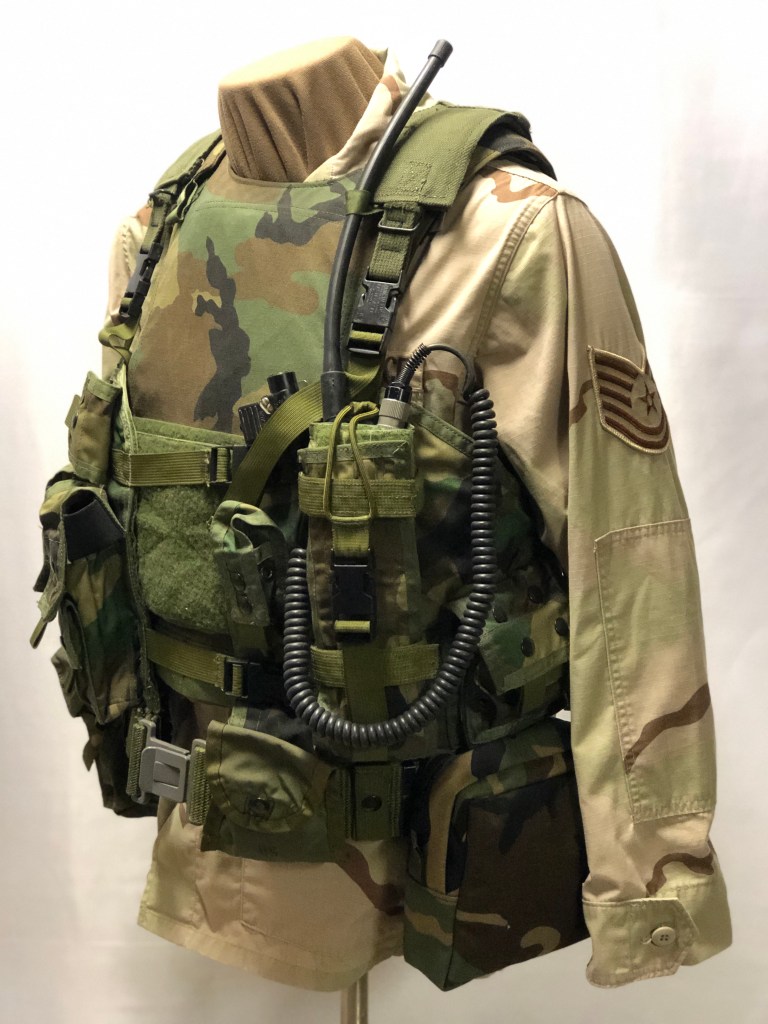
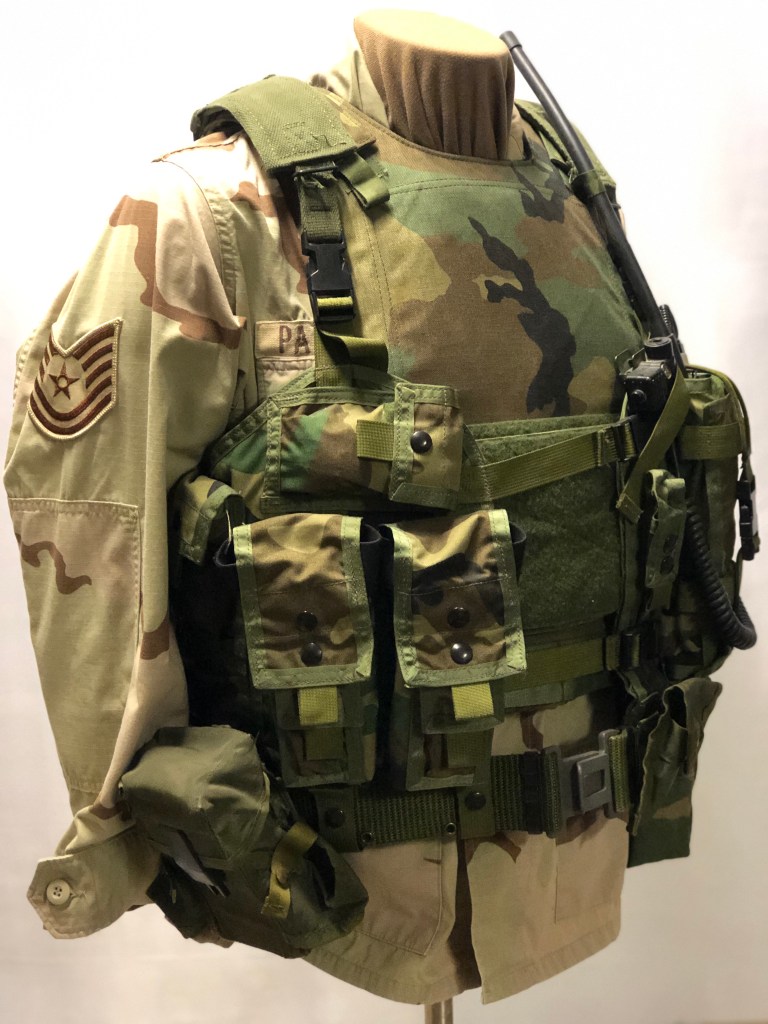
USAF Pararescue Jumpers (PJs) are airmen specialized in rescuing and recovering downed pilots in combat zones. As qualified medics, they also jump in the hot zones to provide medical assistances to troops. Because of those kinds of missions, they had requirements for load bearing vest (LBV) that could carry a lot of ammo, medical equipment, and various of rescue tools. To fill in this requirement, Eagle Industries created a specialized LBV, the Air Rescue Vest.
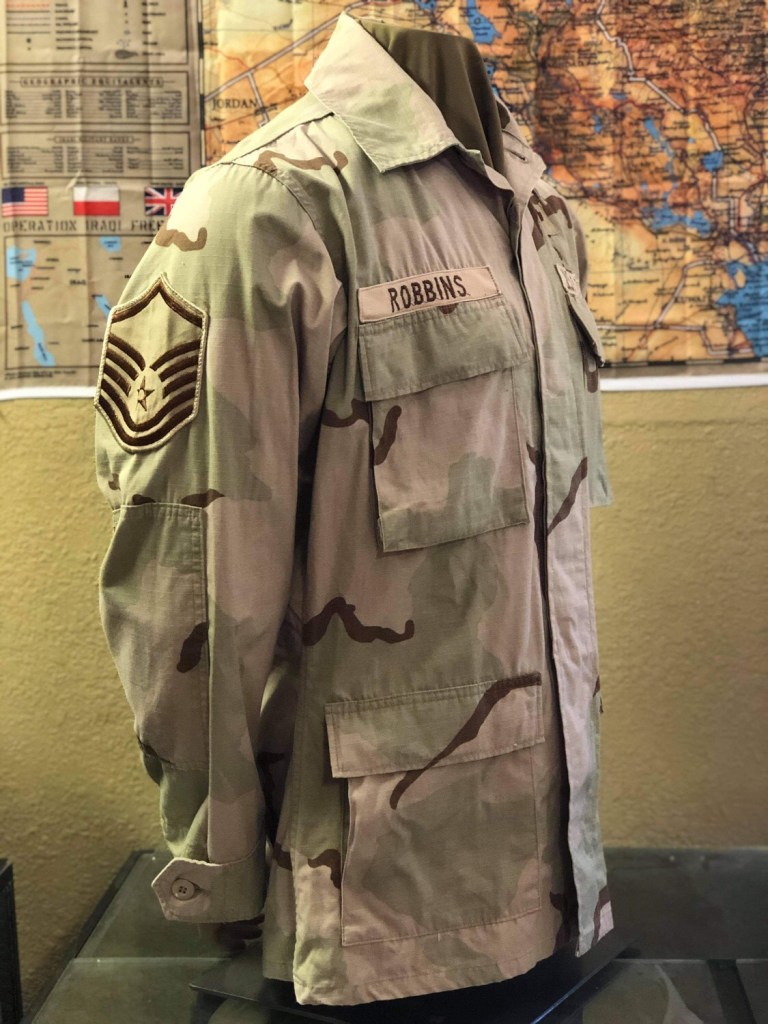
The vest is displayed with a DCU that came from a PJ. The veteran removed the name tape for privacy, however, the rest of patches are intact. You can see that he was Senior Master Sergeant and has badges to denote his qualifications: Master Aircrew Wings (Enlisted), Master Parachutist Wings, and Scuba.
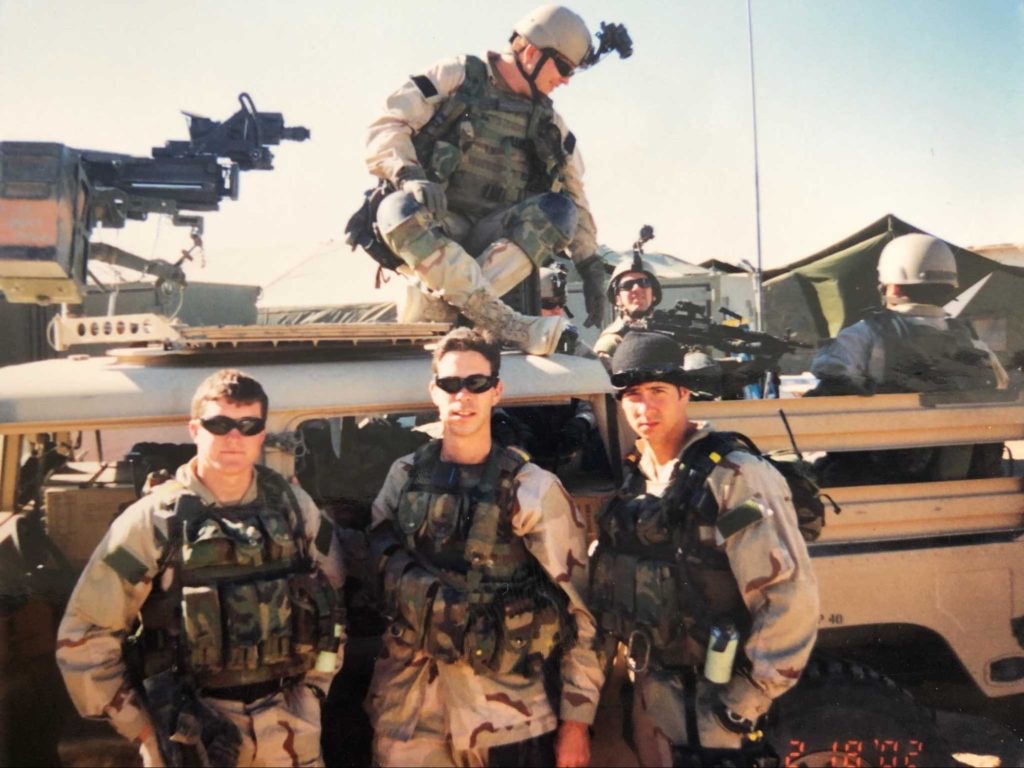
Pararescuemen with the 301st Rescue Squadron return with a downed pilot from a successful rescue mission April 8, 2003 at a forward deployed location in southern Iraq during Operation Iraqi Freedom. – U.S. Air Force photo by Staff Sgt. Shane A. Cuomo
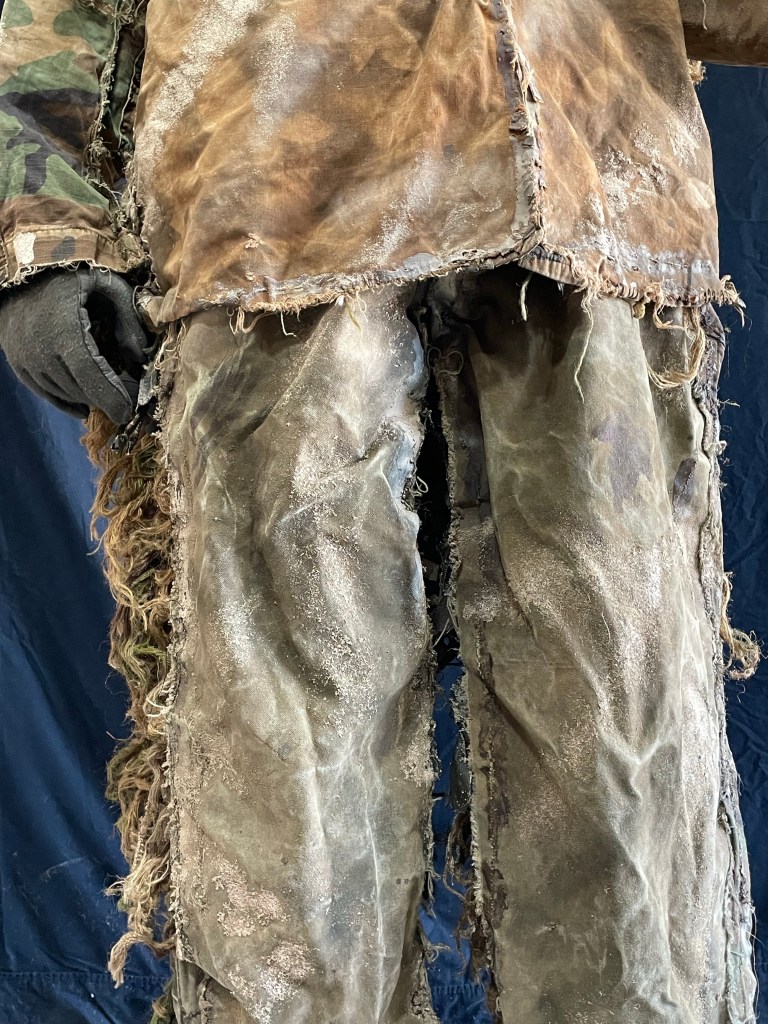
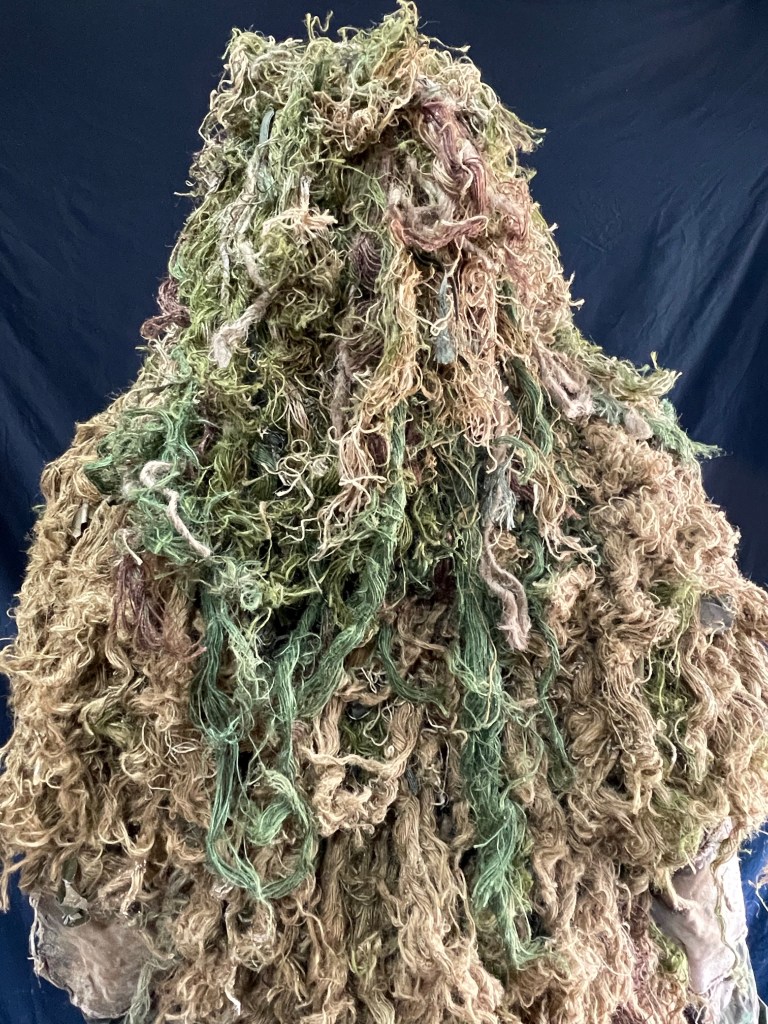
The Ghillie suit worn by US. Army sniper who was in 25th Infantry Division’s Long Range Surveillance Detachment. He worn this in Eastern Afghanistan, where it is more wooded and greener than the rest of Afghanistan. He supported the Special Forces operations by over watching the objective and providing sniper support, and as well covering the extraction (exfil) routes. The LRSD’s core mission is surveillance of enemy activities and provide intelligence to the HQ of 25th Infantry Division.
Details about the suit: It is handmade with the materials such as a BDU set, fishing net, camouflage net, burlap, jutes, canvas, and few cans of paint. The canvas on front of BDU was from old cut-up Army issued duffel bags. It’s thick material reinforced the front of BDU so the sniper could crawl for long duration. The BDU was sized up so it can be donned quickly. It has recycled straps from ALICE ruck sewn on for resizing. The pants have suspenders taken from cold weather pants and tied on via 550 cords The cuff of blouse have one pocket moved for ease of access to ammo or other essential items.
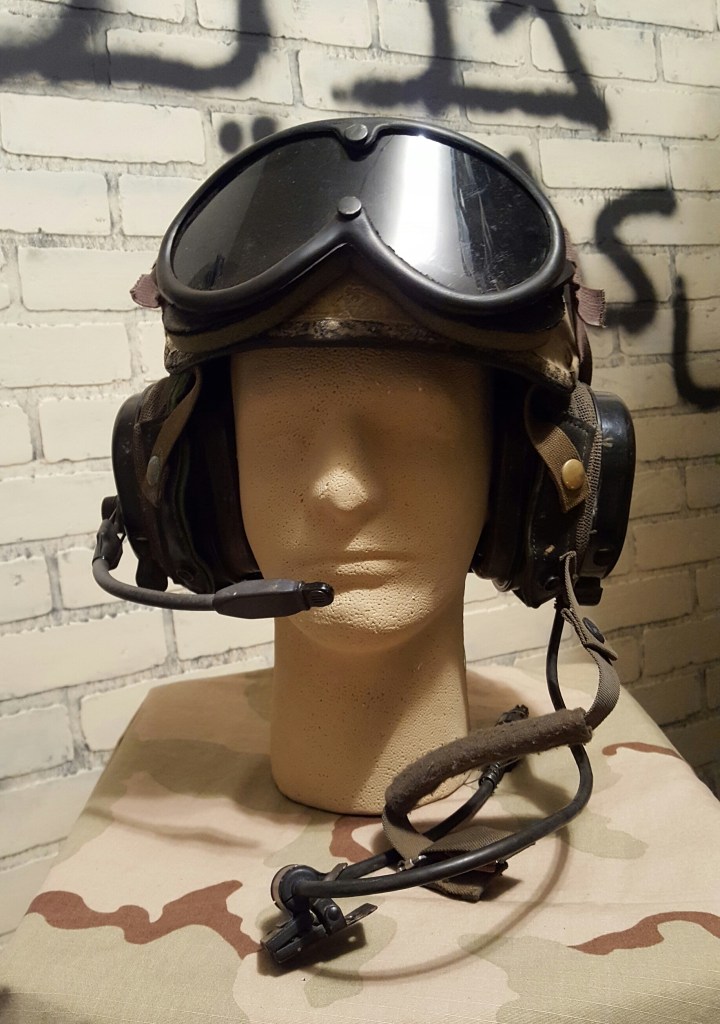
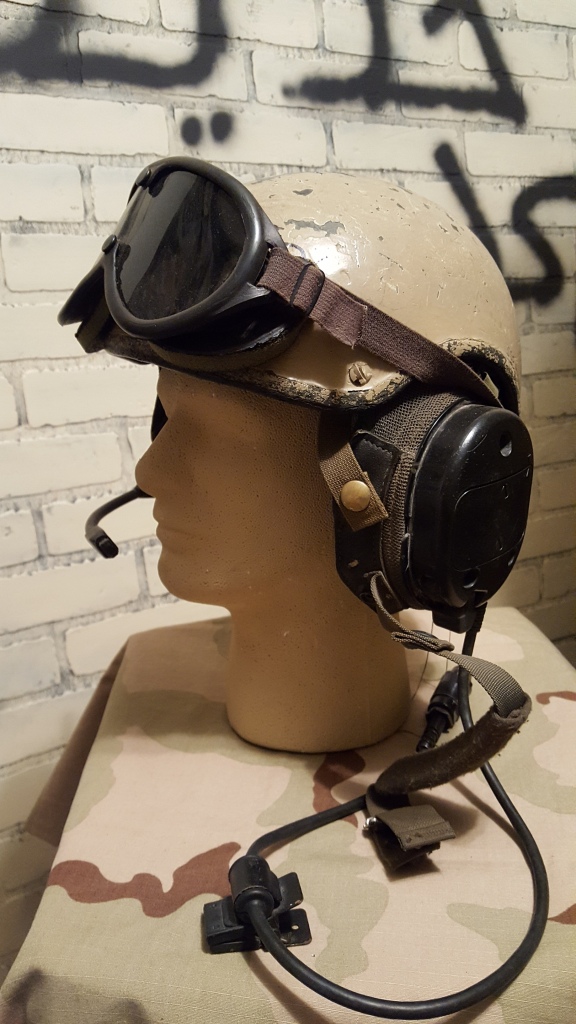
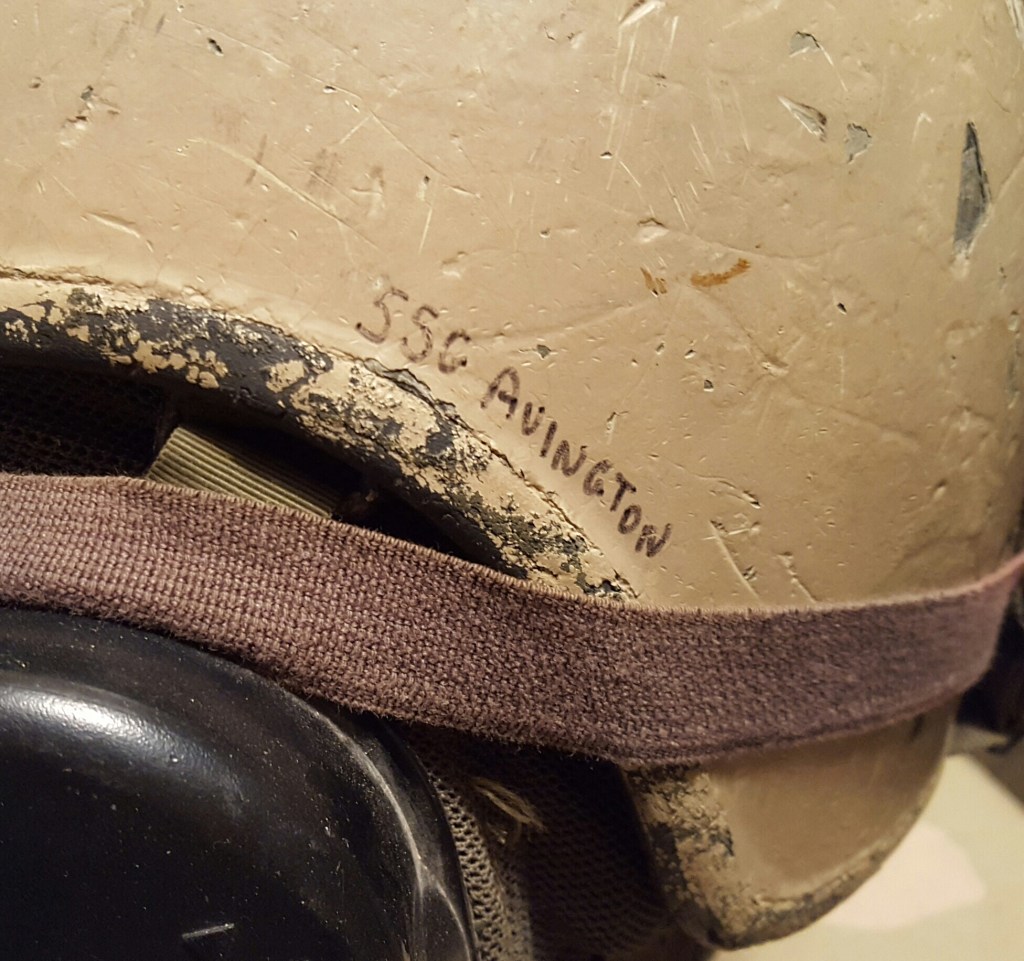
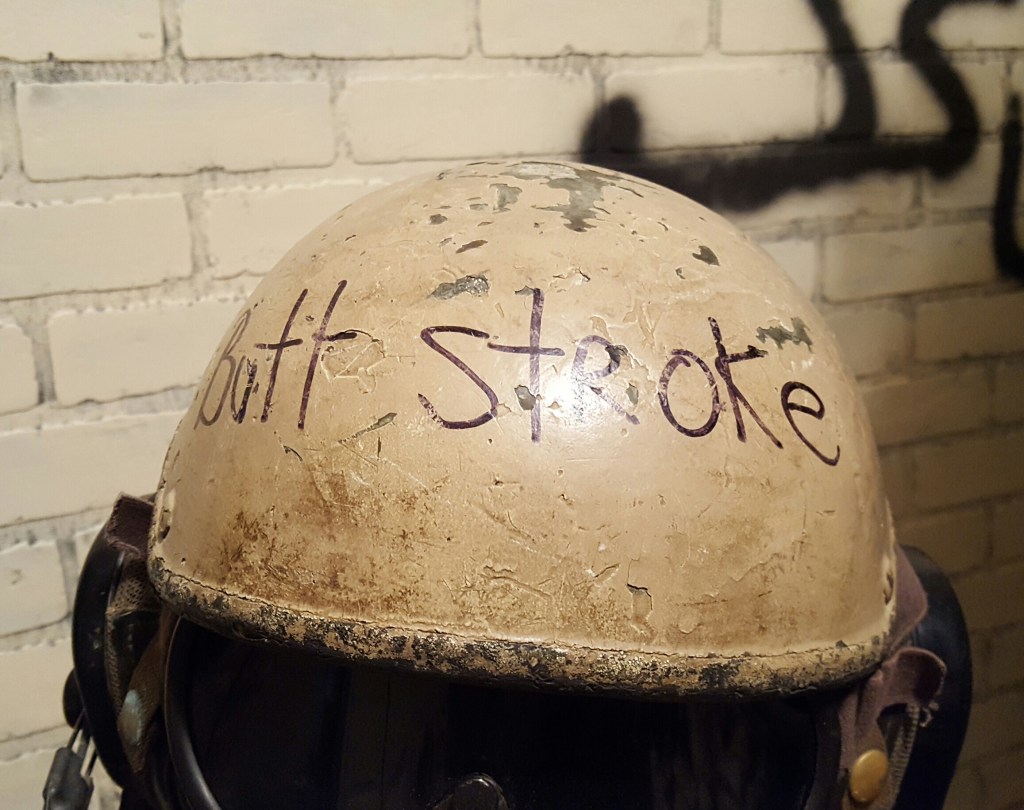
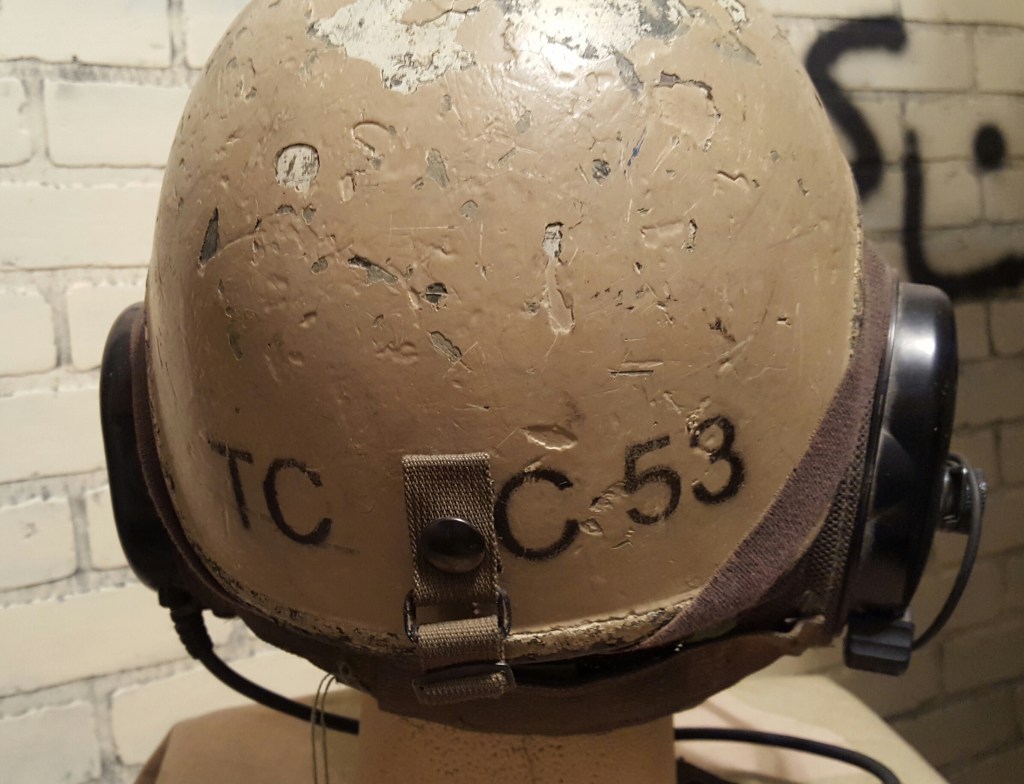
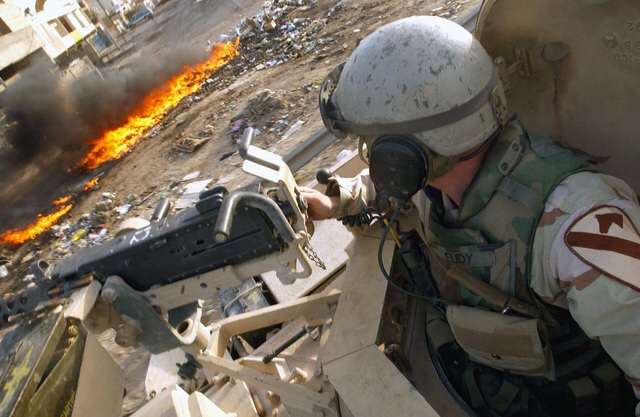
Combat Vehicle Crewman (CVC) helmets were issued to armor units. It has communication headset affixed to it, which could be plugged into armored vehicle radio. This CVC helmet has been painted tan for desert. The stencil TC-C53 translated to “Track Commander, Charlie (company) 53 (vehicle number). “Butt stroke” may have been a nick name of SSG Avington, or written as a joke.
The Air Force desert combat uniform (DCU) has enlisted aircrew wings and medical technician badge, Master Sergeant ranks, named to Robbins. By researching the name online, the history and face behind this DCU were found.
Msgt. Jason Robbins was an Independent Duty Medical Technician, assigned to the 1st Special Operations Support Squadron/Operational Support Medical Flight. His squadron falls under Air Force Special Operations Command. He was a flight IDMT aboard air rescue helicopters and aircrafts including MH-53 Pavelow and MC-130. His job involves assessing, evaluating, diagnosing and treating patients in flight during rescue operations.
In 2009, he become Combat Aviation Advisor with the 6th Special Operation Squadron (AFSOC). Later on, he would become Chief Medical Enlisted Force at AFSOC headquarters.
Based on his ribbons on the published photo, he has seen multiple deployments to Afghanistan and Iraq.
(Disclaimer: the information found on the individual is available publicly via published articles, so I believe no OPSEC nor privacy was violated).
On second year of war in Afghanistan, US. Military launched Operation Anaconda, to squeeze and destroy the remaining Al Qaeda and Taliban fighters in Shahi-Kot Valley and Arma Mountains. The reconnaissance team consisted of Navy Seals and Air Force Combat Controllers were to seize the control of the ridge to establish the observation outpost above positions of Task Force Rakkasan (consisted of troops from the 101st airborne division and the 10th Mountain Division). From the vantage point, they would’ve been able to locate Al Qaeda forces and call in airstrikes. SEALs and STS airmen were transported on US. Army’s 160th SOAR’s Chinook helicopters code named Razor 3 and 4. Once arriving the ridge, Razor 3 began landing for insertion. It Turned out the ridge was already occupied and well fortified by Talibans and Al Qaeda. When ambushed Razor 3 aircrew made an evasive maneuver to get out, the helicopter jerked, a SEAL member, Neil C. Robert who was ready to get off helicopter, fell out of back ramp. Unable to turn around to rescue Neil, Razor 3 had leave the area and make emergency landing. The helicopter had to be abandoned due to damage it sustained from the ambush. Another Chinook, Razor 4, picked up the aircrew and team from Razor 3, brought them back to area, inserted the team below of ridge, away from enemy fire. The team had to scale the ridge to rescue Neil Robert’s. Meanwhile, 1st Battalion, 75th Ranger Regiment, along with few Air Force STS Air controllers and Pararescue Jumpers attaching were the mission’s QRF (Quick Reaction Force) standby at Bagram base. They flew in on Chinooks Razor 1 and Razor 2. Razor 1 with Rangers, reached the ridge, got struck by Rocket Propelled Grenade, it crashed down from 20’ in air. Rangers and STS members held their position and engaged enemies. Combat controller directed multiple close airstrikes, Pararescue Jumpers treated the wounded, while Rangers engaged in heavy firefight. Most of enemy forces on the ridge were eliminated. The troops got evacuated from the ridge. Seven were killed in action. Two Medals of Honor were awarded, USAF CCT Tech. Sergeant John Chapman (posthumously) and USN SEAL Master Chief Britt Slabinski. The ridge was eventually known as Robert’s Ridge, to honor the first KIA of the battle.
Air Force Combat Controller Tech. Sgt John A. Chapman
Air Force Pararescueman Senior Airman Jason D. Cunningham
160th Special Operations Aviation Regiment (SOAR) Sergeant Philip “Spytech” Svitak
Ranger Corporal Matthew A. Commons
Ranger Sergeant Bradley S. Crose
Ranger Specialist Marc A. Anderson
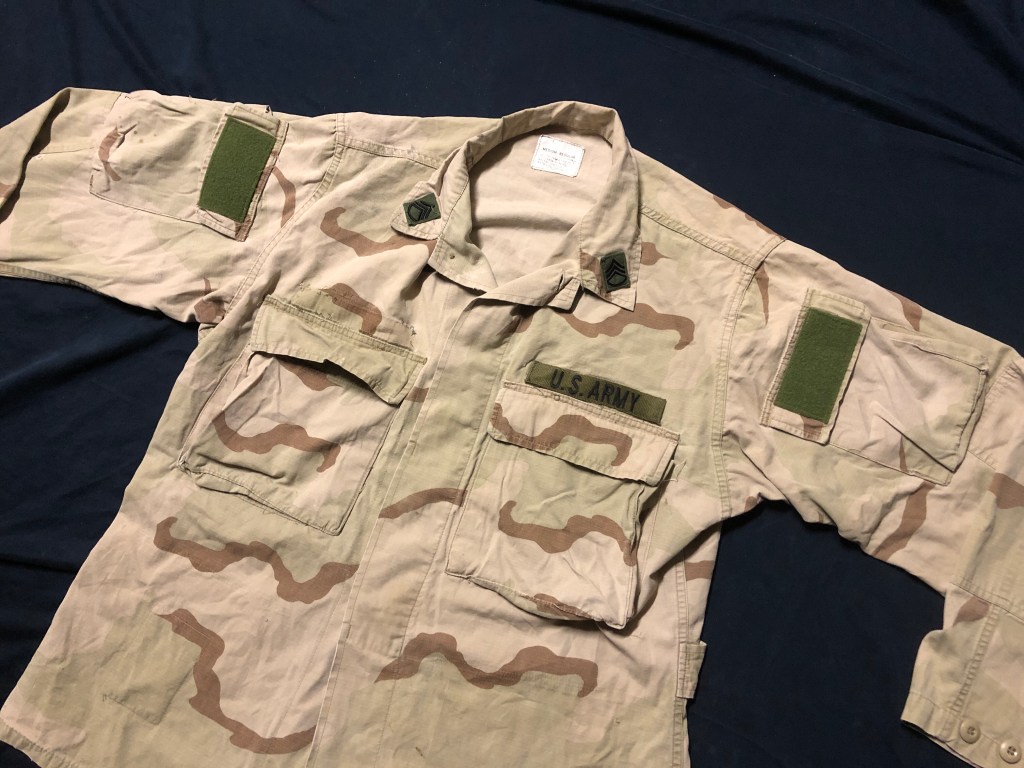
Here are the uniform and equipment as used by Rangers during the battle. The Desert Combat Uniform is modified by moving lower pockets to sleeves with OD green velcro added. This is the earliest modification used by 1/75 Rangers before the standardized modified DCU adopted regiment-wide. The body armor is made by Cerdayne. The pouches are from early MOLLE II and RACK kits, mounted directly on the body armor. Rear of body armor has hydro-bladder and radio pouch mounted directly. The helmet is CGF Gallet, originally issued to Special Operations Forces exclusively. The helmet is paired with comm headset, MSA Sordin.
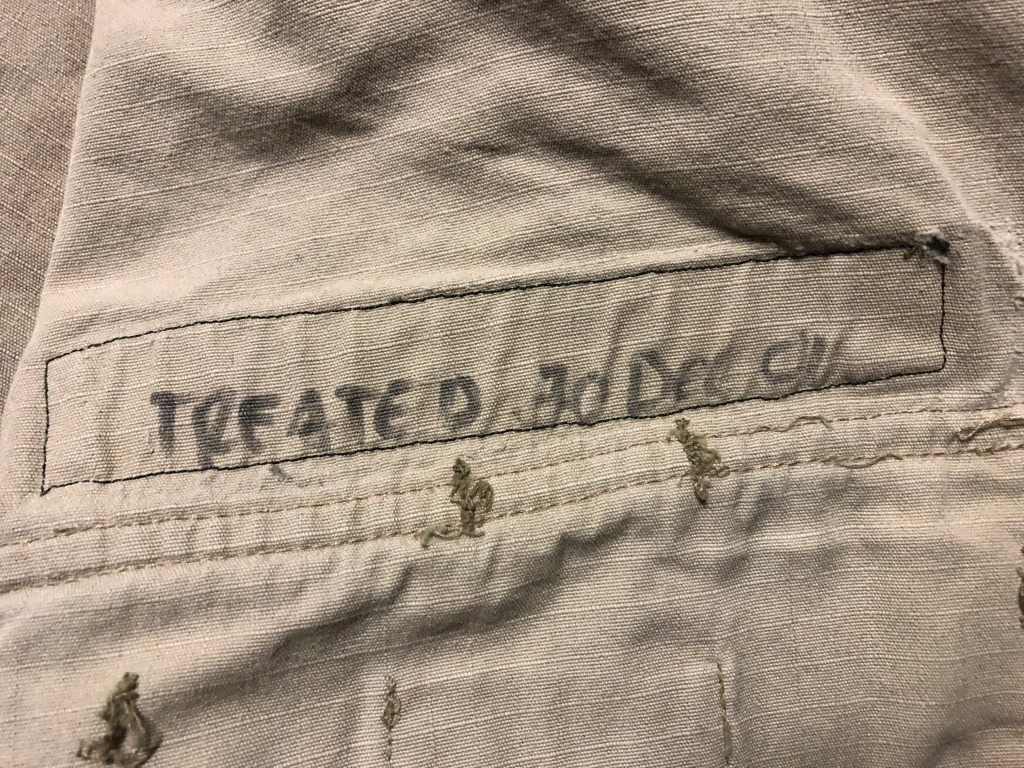
The modified DCU used by 1/75 Ranger from Operation Anaconda. The date written inside jacket was to indicate that it was treated for permethrin, the insect repellent. Screen capture from History Channel’s Warfighters Season 1, episode 9. It shows how Rangers kitted out their gear. Image courtesy of Eric Stebner. Originally posted on Coffee or Die’s article. The article has more details on the battle from the a Ranger’s perspective. Read it here: https://coffeeordie.com/roberts-ridge-video/
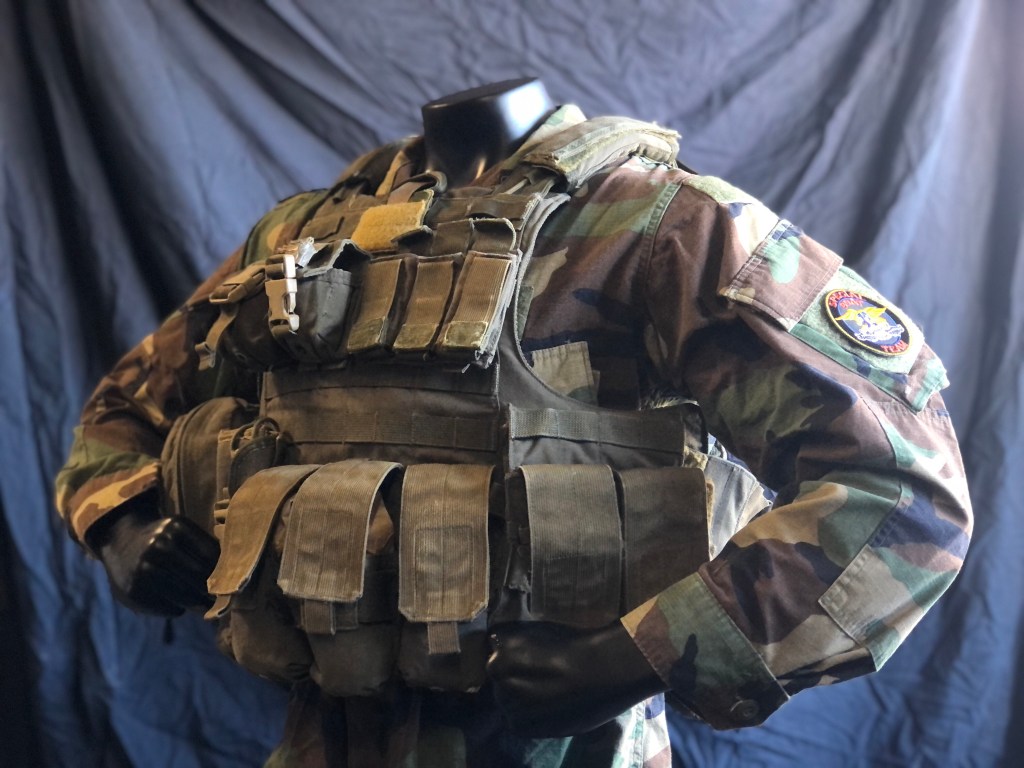
The modified uniform and equipment worn by Special Warfare Combatant-Craft Crewman (SWCC) from the SBT-12. US. Navy SBTs are part of Naval Special Warfare Command. Those maritime special operations boat teams have vessels of heavily armed small crafts, their mission typically involve but not limited to, infiltration/exfiltration of US. Navy SEALs and other Special Operation Forces (SOF).
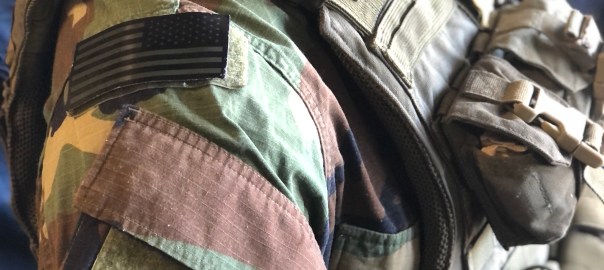
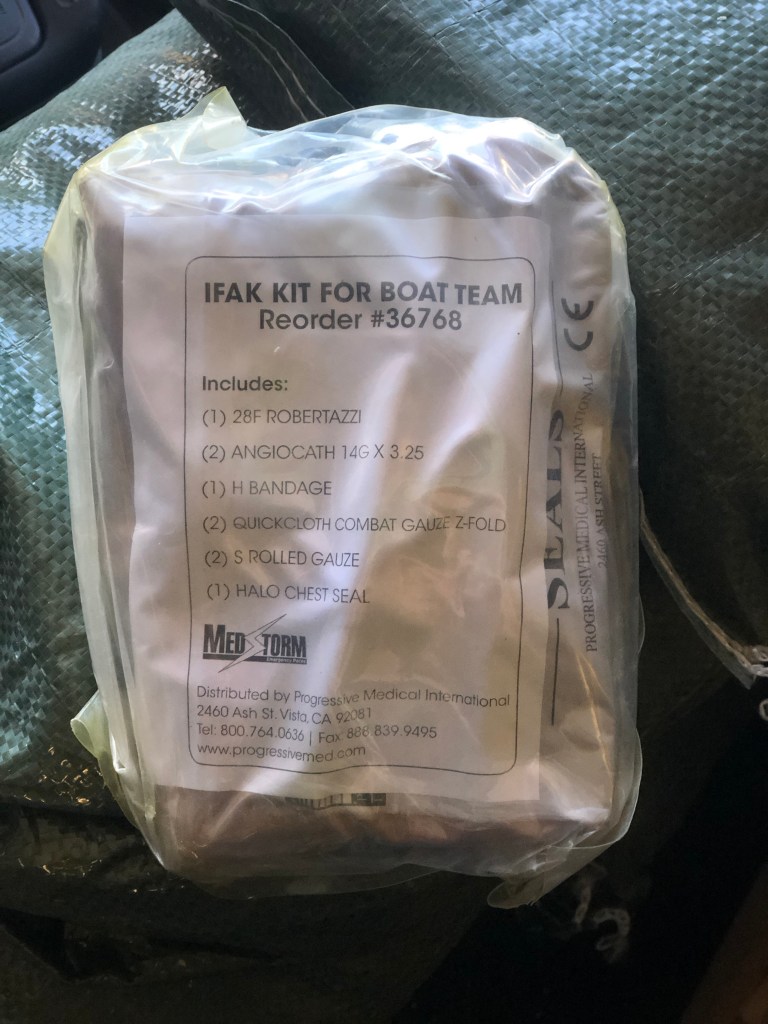
OD Green infrared flag patch and SBT-12 patch in subdued colors on NSW modified BDU. Full color version of SBT-12 patch. Maritime CIRAS body armor made by Eagle industries. It has a useful feature for sailors on small water craft: A pull cable (on collar area of vest) can quickly disconnect the front and rear panels in event of emergency. Individual First Aid Kit (IFAK) in sealed and waterproofed bag. Made for Navy small watercraft crewmen.Photographer: MC2 Michelle Kapica; Credit: U.S. Navy; Copyright: Public Domain
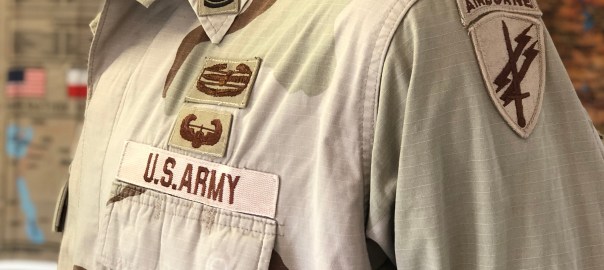
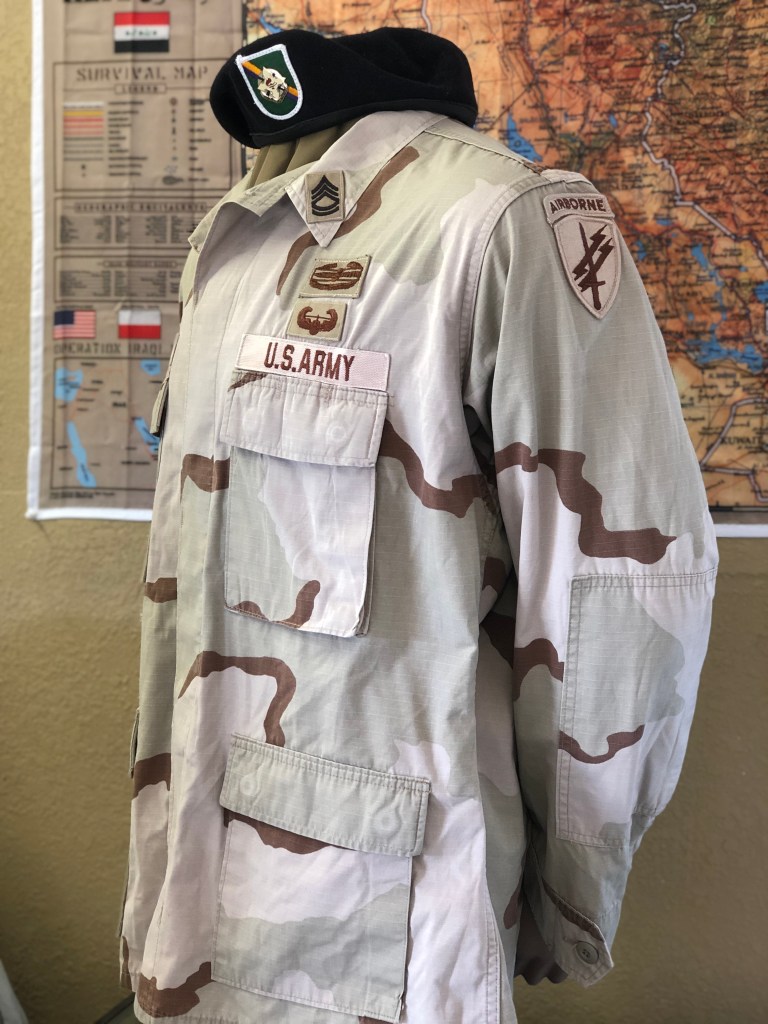
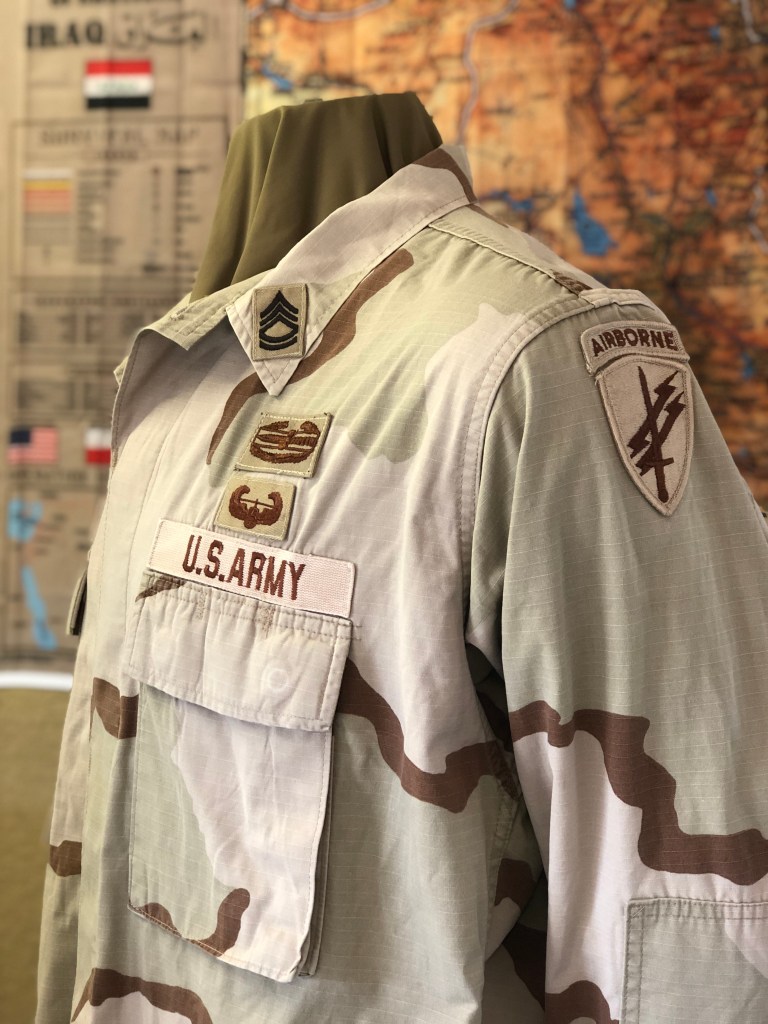
The Desert Combat Uniform (DCU) and beret belonged to SFC Shawn McElravy, who was NCO (Non-Commissioned Officer) in charge of the 1290th Psychological detachment. The detachment was made up of men from 361st Psychological Company. The 361st is part of the US. Army reserve unit, 12th Psychology Operations Battalion. The unit was activated in 2003 then deployed to Mosul, Iraq in 2004-05 to support the 25th Infantry Division’s Stryker brigade. The detachment provided valuable support: Information war. The detachment would utilize press equipment such as large printers and heavy duty industrial paper cutting machine, with capabilities of printing flyers, airdrop leaflets, and posters. They also utilized various tools including but not limited to, broadcast equipment and loudspeakers. They used any tools that would enable them to deliver the information to local populations. More information, details, and images can be found here: http://www.psywarrior.com/361stPsyopIraq.html
SFC McElravy’s beret, as worn by 361st PSYOP Company soldiers- the 12th POB distinctive unit insignia (DUI) on USACAPOC flash.
The DCU has United States Army Civil Affairs and Psychological Operations Command (USACAPOC) Shoulder Sleeve Insignia, the command 361st PSYOP company falls under, and a combat patch of 25th Infantry Division to reflect that he was deployed and attached with them. US flag patch is made of 3M type reflective material, mounted on Velcro. The Infrared reflective (IR) flag patch was adopted by Stryker Brigades at the time to assist soldiers with recognizing friendly/foe while wearing night vision goggles (NVG). DCU has air assault wing and Combat Action Badge (CAB). The CAB only awarded to non-infantry soldiers who saw combat, which indicated that SFC McElravy had his share of combat during the deployment.
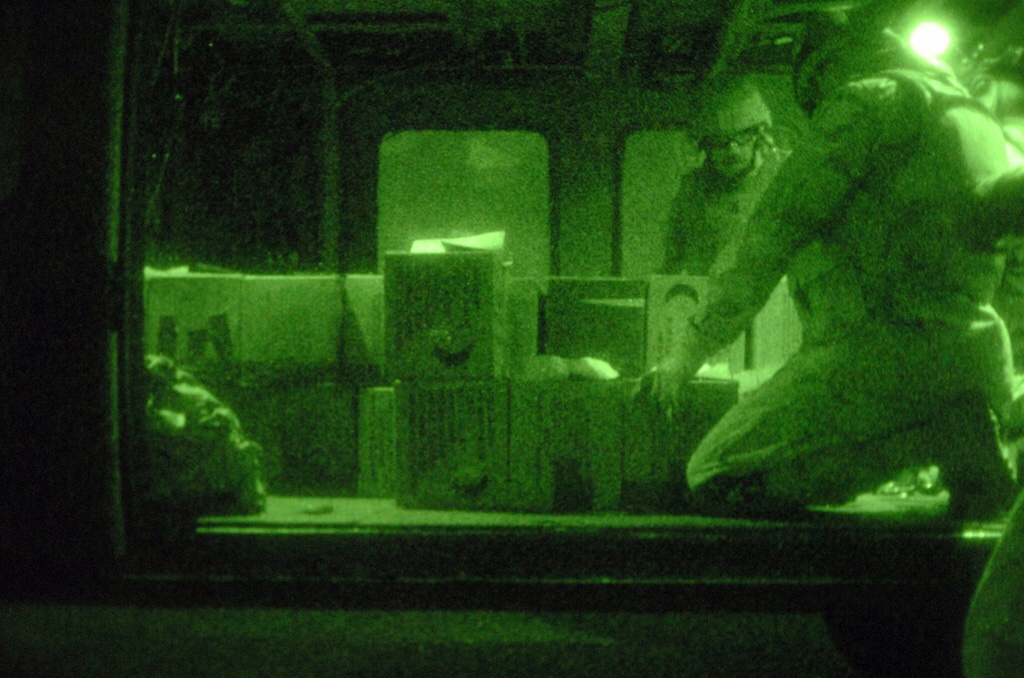
US Army (USA) Soldiers from 1290th Tactical Psychological Operations (PSYOPS) Detachment (Stryker Brigade Combat Team), 361st PSYOPS Company (CO), Bothell, Washington (WA), load boxes filled with leaflets into a trailer for distribution throughout Mosul, Iraq, during Operation IRAQI FREEDOM. (Image: Released to Public Combined Military Service Digital Photographic Files)Nightscope shot of US Army (USA) Soldiers from 1290th Tactical Psychological Operations (PSYOPS) Detachment (Stryker Brigade Combat Team), 361st PSYOPS Company (CO), Bothell, Washington (WA), loading boxes filled with leaflets onto a USA UH-60 Black Hawk for distribution over Mosul, Iraq, during Operation IRAQI FREEDOM (Image: Released to Public Combined Military Service Digital Photographic Files)
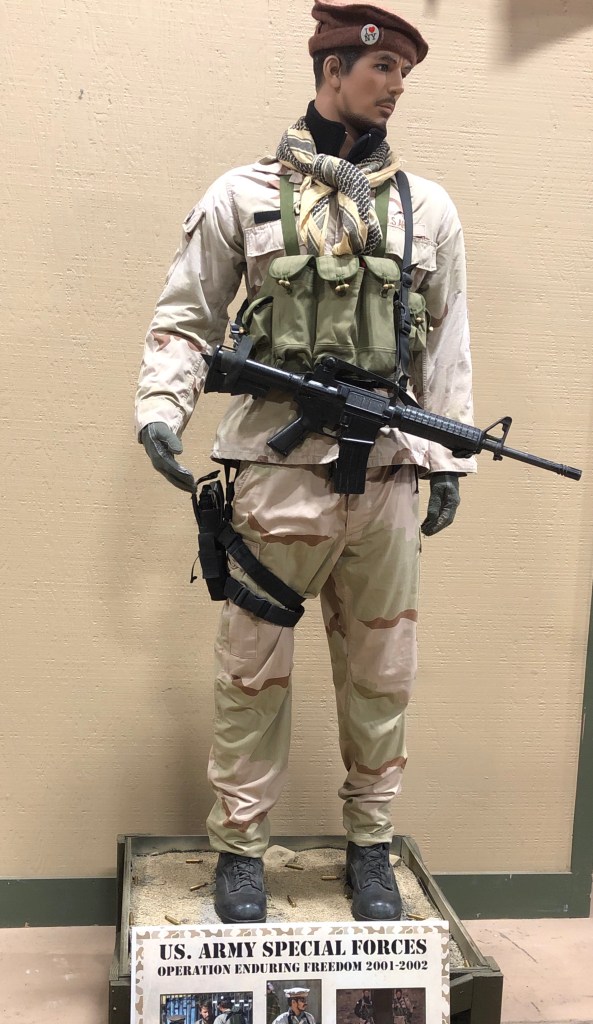
The display is currently on loan to American Armory Museum for their Operation Enduring Freedom exhibit.
Anti-Taliban leader Gul Agha Sherzai’s Pashtun force liberated Kandahar from Taliban’s control in late 2001. There were still pockets of Talibans and (foreigners) Al Qaeda fighters throughout the city. Sherzai’s forces captured few wounded hard core Al Qaeda fighters, who were then brought to Mir Wais hospital for treatments. On December 7, 2001 nine Al Qaeda fighters overpowered their captors, armed and barricaded themselves in a wing of hospital, besieged it. Al Qaeda fighters handed over two of their severely wounded fighters who weren’t able to fight, to Sherzai’s forces. One of fighters committed suicide by blowing up himself with a grenade. Six Al Qaeda fighters remained.
US. Army 5th Special Forces Group (Airborne)’s ODA 524 team had arrived in Kandahar just two days earlier to replace another team, ODA 574 due to heavy casualties from accidental friendly air strike incident. When ODA 524 arrived on scene, Pashtun leader Sherzai insisted that Americans could not enter the Mir Wais hospital but insisted they train and prepare Sherzai’s own force for assault. With the siege ongoing, the ODA trained the 15 best fighters selected from Sherzai’s force for assault. For a few weeks, these Pashtun fighters were trained in urban warfare and Close Quarter Battle.
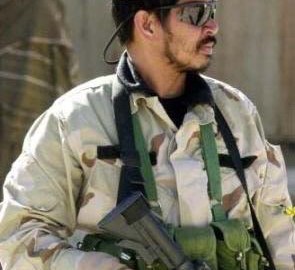
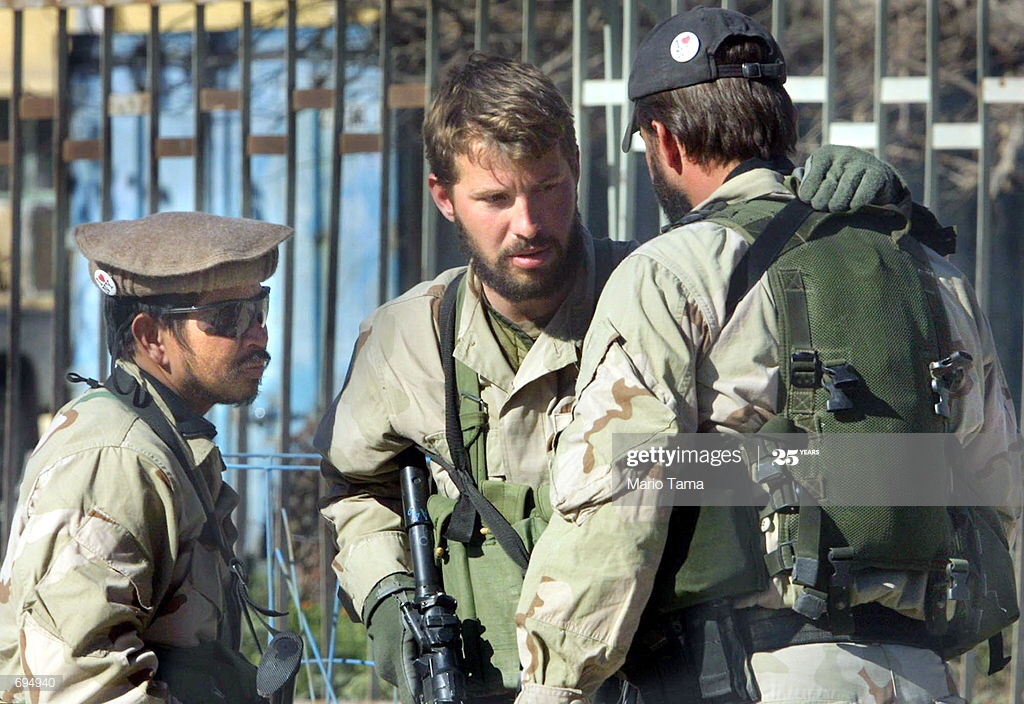
Men from ODA 524. Note the “I love NY” pins. Image source: Getty images
The ODA emplaced and blew breaching charges on the hospital wall creating an entry point for Sherzai’s assault force. The breaching caught Al Qaeda fighters off guard however, Sherzai’s assault force moved too slowly, allowing Al Qaeda fighters to recoup and put up a heavy resistance. At one point during the assault, a grenade blew up wounding multiple Pashtun assaulters, forcing them to retreat. On the second assault attempt, the remaining Pashtun assaulters were no longer motivated, requiring the ODA to step in. The ODA conducted this second assault themselves. After tossing multiple grenades and heavy gunfight, they successfully took down all the six Al Qaeda fighters. The men of ODA 524 ended a 50 days siege without taking casualties.
The two severely wounded fighters were treated and transferred to United States’ Guantanamo Bay Naval base in Cuba for the high security detention camp controlled by Joint Task Force- Guantanamo (JTF-GTMO).
Aftermath of successful assault. Image source: AP photo and the BBC News article.
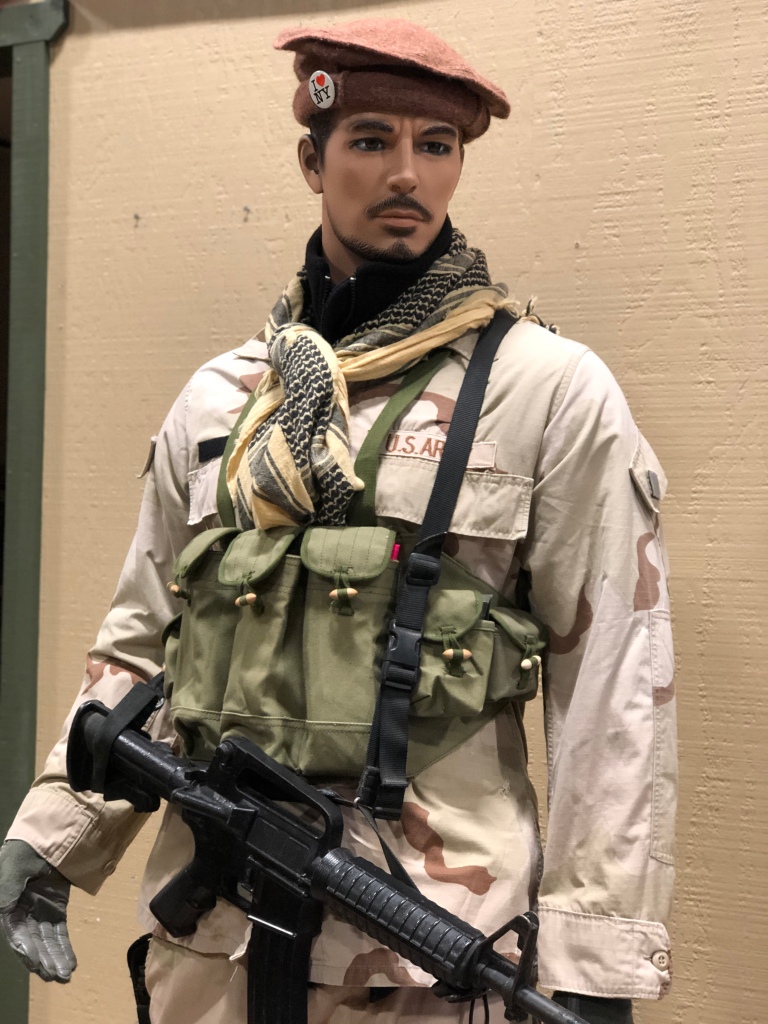
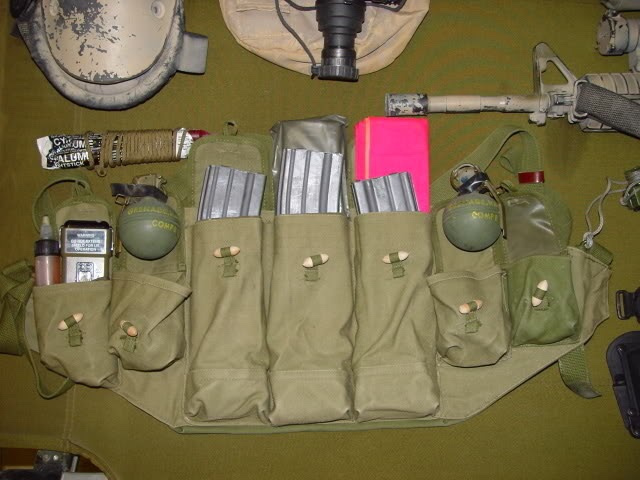
The equipment on the mannequin display: Pakol hat and Chinese made “Chicom” chest rig commonly worn by Afghans; also worn by Special Forces soldiers to blend in their allied fighters and local population. The “I love NY” pin was worn by ODA members as a tribute to 9/11. The desert camouflage uniform (DCU) was modified by relocating pockets to sleeves for ease of access while wearing vest or chest rig. Strips of Velcro were added so branch/name tags can be removable for anonymous reason and Velcro squares on sleeves were for reflective/IR squares with purpose to distinguish from friendlies to foes. Under the modified DCU is Extreme Cold Weather Clothing System (ECWCS) fleece jacket.
The “barrack” photo taken by Special Forces soldier showing how he utilized his “Chicom” chest rig. Image source: Unknown/ Open source
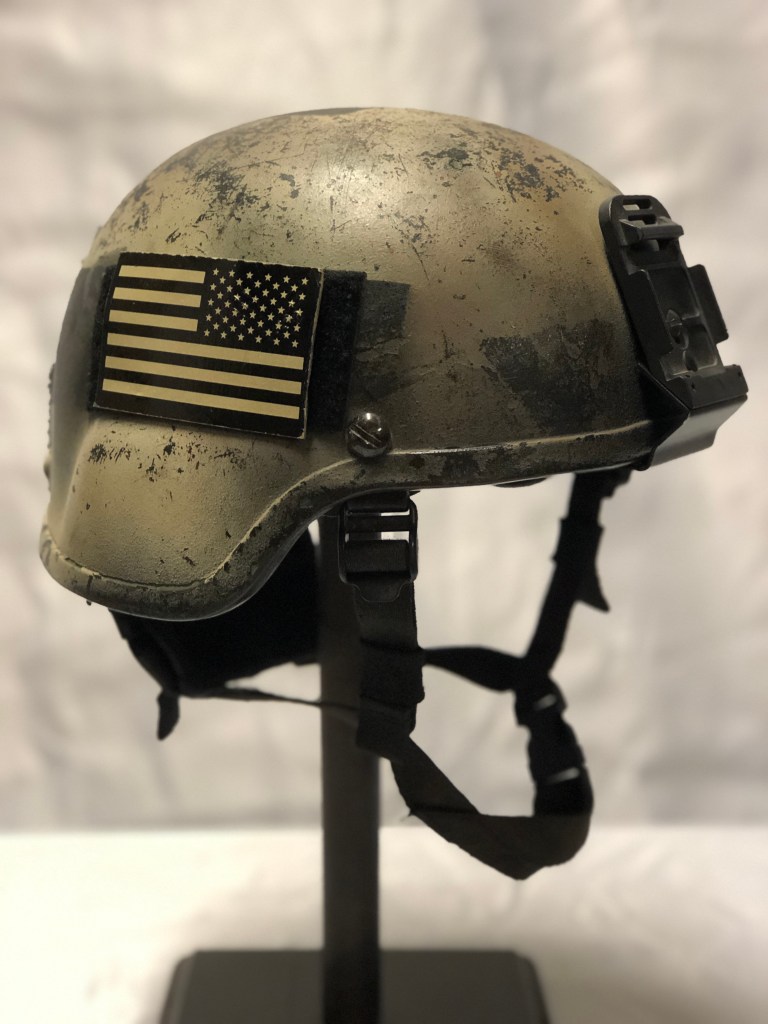
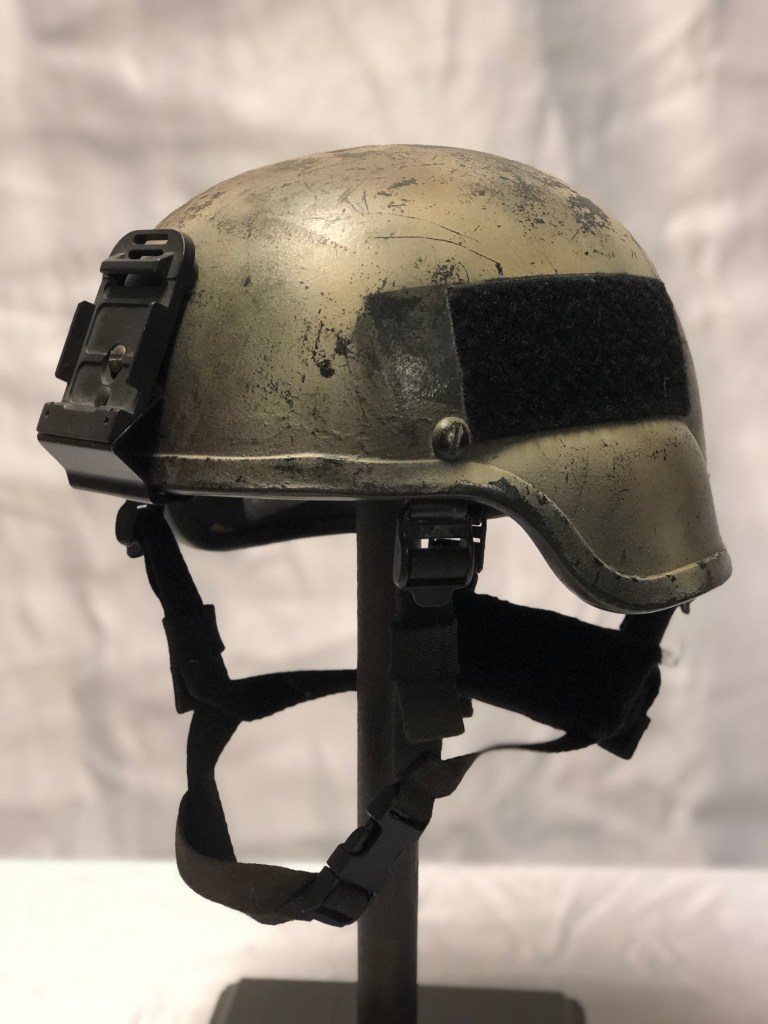
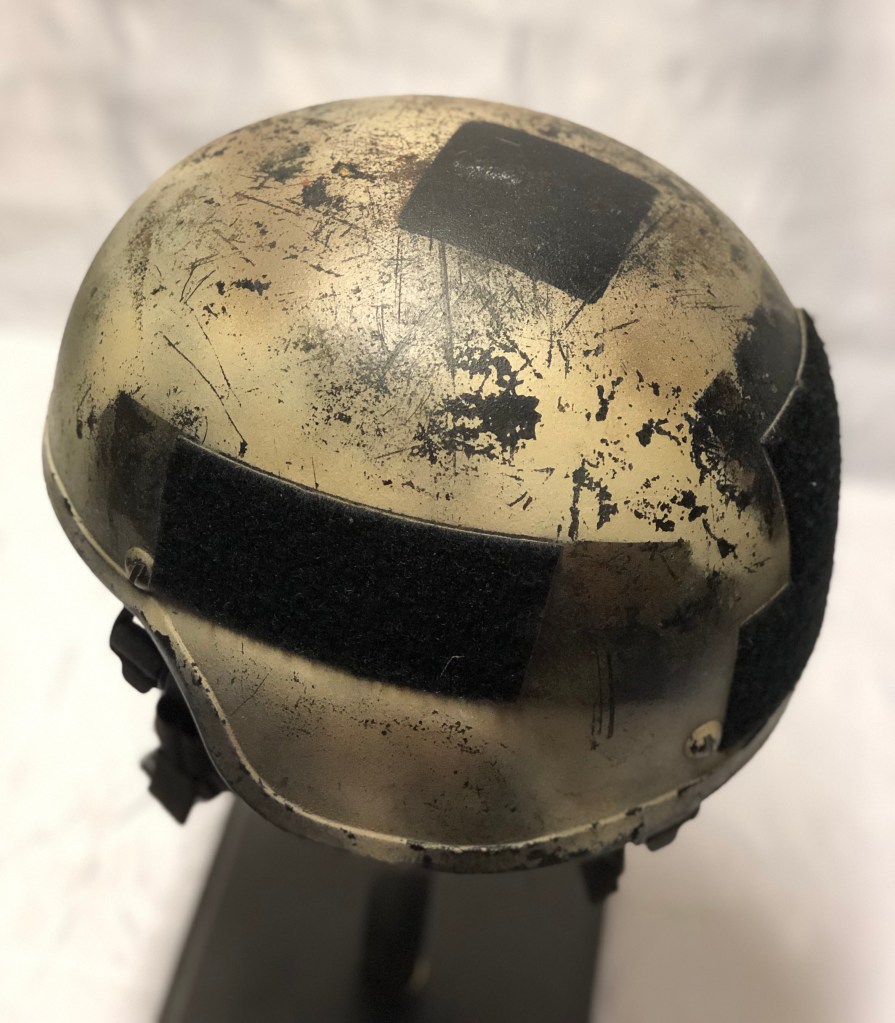
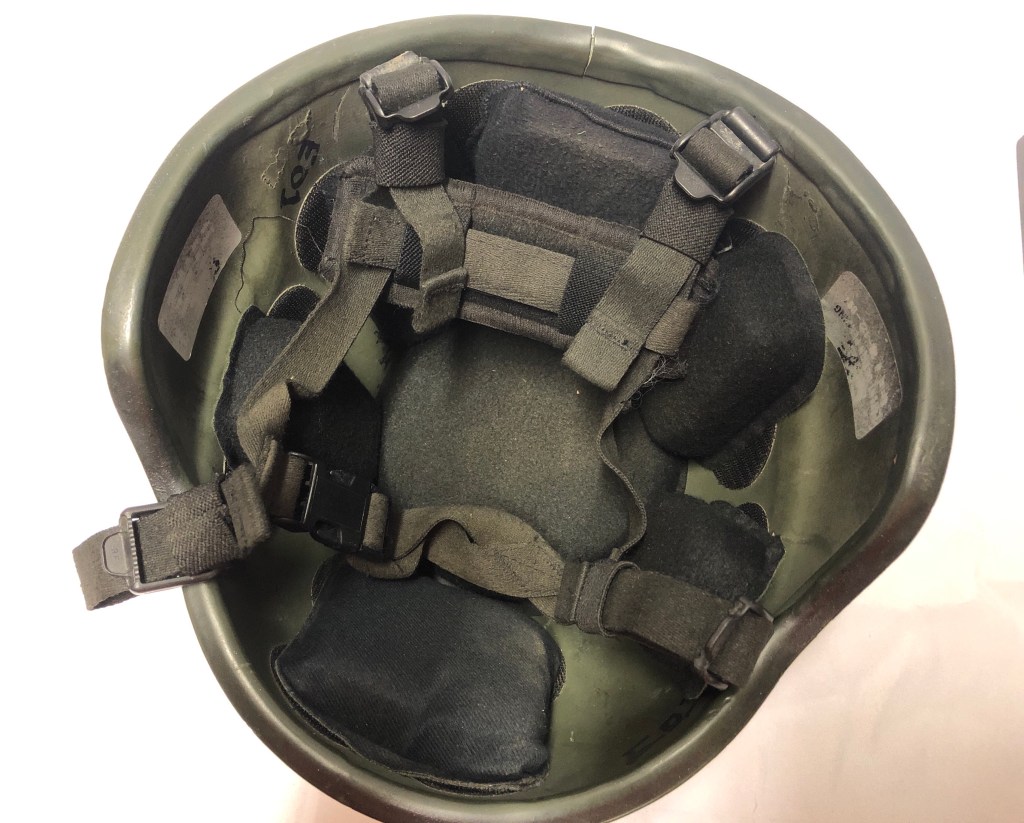
An original helmet with sprayed camouflage pattern and strips of Velcro added for various of attachments including NVG mount accessories or patches. Special Operations Forces (SOF) troops typically customize or personalize their helmets to meet their operational needs or individual preference. This TC2000 is made by CGF Gallet, the original manufacturer of the helmet series before the company was bought out by MSA. The CGF version was the first TC2000 adopted by US. Military exclusively for SOF units while the conventional units still had PASGT helmets.
The CCT LBV has been modified; the factory shoulder pads were replaced with Vietnam War era M-1956 H-harness by operator, while the real reason unknown but the vest shoulder straps had reputation of being weak and old Vietnam War era shoulder pads has more slim feature. While the vest was originally designed for Combat Controller team, it was also used heavily by Pararescue Jumpers due to radio pouch.
Tech. Sgt. Keary Miller, pararescueman from 123rd Special Tactics Squadron, won silver star before the award upgraded to Air Force Cross for his actions in the Battle of Roberts Ridge (Takur Ghar, Afghanistan). This equipment set up displayed here at GWOT museum is based on equipment Miller worn in the battle. The equipment originally worn by Miller is displayed at Warrior Airman exhibit at National Museum of the United States Air Force.
(From left to right) Tech. Sgt. Keary Miller, Senior Airman Jason Cunningham and Staff Sgt. Gabe Brown about three weeks before the battle. Behind them is a MH-47E, the same type of helicopter that took them to Takur Ghar. (U.S. Air Force photo)